Showing posts with label Toyota. Show all posts

Thursday, January 20, 2011

Toyota Auris, 2010

Toyota Auris, 2010


Launched in 2007 at the heart of the highly competitive European C-segment, the Toyota Auris has built a solid reputation for roominess, comfort, practicality and reliability combined with a secure, economical driving experience.

The application of Toyota Optimal Drive across the Toyota Auris range in 2009 has already effected a significant improvement in the model's environmental performance, lowering CO2 emissions to segmentbest levels. Even before the 2010 introduction of Hybrid Synergy Drive to the model range, the overall Toyota Auris CO2 average has been reduced from 152 g/km in 2007 to 142 g/km in 2009.

Exclusively designed for the European market, the Toyota Auris HSD introduces full hybrid technology to a core model at the heart of the Toyota line-up, the first step in the deployment of HSD (Hybrid Synergy Drive technology) across the company's entire European model range by the early 2020s. Built at Toyota Motor Manufacturing UK, it targets an important shift in customer perceptions of full hybrid technology.
Toyota Auris

With remarkably low 89 g/km CO2 emissions , the Toyota Auris HSD plays a significant role in further reducing Toyota's whole-fleet CO2 average which, having fallen by 16 g/km between 2008 and 2009, already stands at just 130 g/km.

Design
The Toyota Auris 2010 combines dynamic exterior design changes with extensive interior improvements in quality, materials, ergonomics, driving comfort, and visual appeal. The Toyota Auris HSD incorporates several unique styling details to improve the car's aerodynamic performance. The interior incorporates hybrid-specific instruments, switchgear and upholstery.

Exterior design: a stronger, more confident road presence
Redesigned bumpers have increased the front and rear overhangs by 15 mm and 10 mm respectively. As a result the Toyota Auris 2010 has increased in overall length by 25 mm to 4245 mm, while the long, 2600 mm wheelbase remains unchanged.

The latest addition to the model line-up, the Toyota Auris HSD incorporates several unique exterior design features which both improve the car's overall aerodynamic efficiency and indicate the presence of Toyota's Hybrid Synergy Drive powertrain.

The upper grille opening has been optimised to help the air flow smoothly over the upper half of the body, and the size of the lower grille has been enlarged to reduce airflow resistance as well as improving engine cooling efficie
Housing a revised foglamp configuration, the flat, vertical surface of the bumper corner not only reinforces the Toyota Auris HSD's broad stance and driving stability, but also corrects airflow as it passes over the front wheels to minimise wheel arch turbulence.

Allied to a 5 mm lowering of vehicle ride height and a choice of purpose-made, 15" or 17" alloy wheels with integrated, aerodynamic caps and low rolling resistance tyres, a large, roof mounted rear spoiler further improves the Toyota Auris HSD's aerodynamic efficiency.

Interior design: improvements in quality, ergonomics and visual appeal
Soft touch materials now cover the top of the driver's instrument cluster and the upper glove box, and the seat upholstery has been upgraded across the range. The height of the centre console storage box has been raised by about 50 mm, and it now functions as an armrest. A new, more comfortable steering wheel incorporates redesigned audio and Bluetooth phone control switches.
The unique, bridged centre console which brings the gear lever, handbrake and instrumentation within the closest possible reach of the driver has a new, bright metallic finish matched by the door handles. The handbrake design has been revised with a new lever release button, a tactile, ergonomic grip and lower seating in the release position.

Control panel colour and finish changes have enhanced switch layout visibility, and the illumination of the Optitron meter dials has been changed to white for improved clarity and visibility.

In conjunction with the introduction of Hybrid Synergy Drive, the Toyota Auris HSD interior features several significant modifications. The driver's instrument binnacle has been revised, with the tachometer replaced by an Eco Drive Assist Monitor. The centredial information panel includes additional, Hybrid Synergy Drive- specific information such as Energy Flow and Eco Drive Result monitors.

Powertrains and driving dynamics
The Toyota Auris 2010 powertrain line-up features a choice of full hybrid drive, and three petrol and three diesel engines offering the performance- and economy-enhancing benefits of Toyota Optimal Drive. The introduction of a Hybrid Synergy Drive model makes this is the most comprehensive range of powertrains available in the C-segment, catering for every customer requirement.

1.33 litre Dual VVT-i with Stop & Start system
The 1.33 litre Dual VVT-i petrol engine generates 73 kW/ 99 DIN hp and maximum torque of 128 Nm at 3800 rpm, while returning an average fuel consumption of 6.0 l/100 km and CO2 emissions of only 139 g/km.

The unit benefits from numerous Toyota Optimal Drive engine optimisations. A combination of lightweight technology, a resin cylinder head cover and intake manifold, and a remarkably compact design has effected a substantial reduction in engine weight and size. Combustion efficiency has been improved through the use of a high efficiency intake port, a high compression ratio and long reach spark plugs.

Extensive friction reduction measures include enhanced engine block rigidity and bore circularity, an improved valve roller rocker arm design with a new camshaft profile, small, lightweight pistons with a low friction coating, low viscosity oil and a water jacket spacer.

Toyota Optimal Drive's environmental technologies are represented by the application of a wide ratio 6-speed manual transmission and optional, Stop & Start System technology.

1.6 and 1.8 litre Valvematic petrol engines
The 1.6-litre Valvematic engine develops 132 DIN hp and classleading maximum torque of 160 Nm at only 4400 rpm. When equipped with a 6-speed manual transmission, the unit returns a combined cycle fuel consumption of 6.6 l/100 km and generates CO2 emissions of only 152 g/km. MultiMode transmission further reduces both fuel consumption and emissions, to 6.3 l/100 km and 146 g/km respectively.

The 1.8 litre Valvematic engine develops 147 DIN hp and maximum torque of 180 Nm at 4000 rpm, yet the engine's combined fuel consumption is only 6.7 l/100 km, and CO2 emissions are 155 g/km. Through the application of Toyota Optimal Drive, both engines benefit from the same lightweight technology, compact design and combustion efficiency engine optimisations as the 1.33 litre unit.

Diesel engines
The three diesel engines in the Toyota Auris 2010 model range also benefit from the extensive application of Toyota Optimal Drive technologies.

Lightweight technology and a compact design have resulted in a marked reduction in engine weight and size. Numerous combustion efficiency enhancing measures include a lower compression ratio, optimised combustion chamber dimensions, enhanced Exhaust Gas Recirculation (EGR) cooler efficiency and stainless steel exhaust manifolds with close-coupled Diesel Particulate Filters (DPF).

The adoption of Piezo injectors is of particular significance. Their high speed reaction time makes multi-phase high speed injection possible. This has the effect of both lowering the rate of combustion expansion and effecting a more thorough burn within the combustion chamber, thus further reducing particulate, NOx and CO2 emissions.

The 2.2 litre engine also benefits from Toyota's Diesel-Clean Advanced Technology (Toyota D-CAT), which incorporates a Diesel Particulate and NOx Reduction filter (DPNR).

1.4 D-4D 90 diesel engine
The 1.4 litre D-4D engine develops 90 DIN hp and maximum torque of 205 Nm at only 1800 to 2800 rpm, and may be equipped with a Diesel Particulate Filter (DPF) for CO2 emissions that are amongst the lowest in the C-segment.

2.0 D-4D 125 and 2.2 D-4D 180 diesel engines
With a DPF fitted as standard, the 2.0 D-4D 125 delivers 126 DIN hp and maximum torque of 310 Nm from 1800 to 2400 rpm. Combined cycle fuel consumption is 5.2 l/100 km and CO2 emissions are 138 g/km.

The Toyota Auris' powerful, 2.2 litre turbodiesel further benefits from Toyota's Diesel-Clean Advanced Technology (Toyota D-CAT), which incorporates a Diesel Particulate and NOx Reduction filter (DPNR). The 2.2 D-4D 180 unit delivers 177 DIN hp and a highly impressive maximum torque of 400 Nm between 2000 and 2800 rpm. Conversely, average fuel consumption is just 5.9 l/100 km, and CO2 emissions only 154 g/km.

6-speed manual and MultiMode transmissions
Every engine in the Toyota Auris 2010 range is mated to a Toyota Optimal Drive six-speed manual transmission featuring wide-spread ratios designed to optimise fuel consumption and lower CO2.

Toyota 4Runner, 2010

Toyota 4Runner, 2010


When the first Toyota 4Runner sport utility vehicle (SUV) was launched back in 1984 it was a revolutionary new vehicle based on the mechanics of the four-wheel-drive Toyota pickup truck. The Toyota 4Runner combined the versatility and go-anywhere ability of four-wheel-drive with the comfort and utility found in passenger cars.

Twenty-five years, four generations and more than 1.5 million sales later, the Toyota 4Runner continues to evolve while remaining close to its roots. The all-new fifth-generation Toyota 4Runner is even more rugged and athletic, and packed with more power and better mileage. A completely redesigned interior and unique cargo area make the newest Toyota 4Runner smarter, more comfortable, and more versatile than ever.

Exterior Styling
The design strategy for the new Toyota 4Runner emphasizes a more rugged, powerful stance. Large diameter wheels and tires were added to not only improve off-road performance, but also enhance the Toyota 4Runner's truck-based characteristics. In addition to its styling emphasis on ruggedness and outdoor adventure, the new design utilizes a combination of Toyota's classic boxy form and progressive styling.

All Toyota 4Runner grades feature rugged new bumpers and wider shoulders, with newly designed head- lamp and tail-light systems, which offer a newly-minted, technical design quality and better nighttime performance. The front ends square fender flares meld with a muscular profile that links with a beefy and square rear bumper and back door.

Aluminum alloy wheels are 17-inches in diameter on SR5 and Trail grades and 20-inches on the Limited, and include a full size spare.

The Trail grade is designed to maximize off-road performance with a superior approach and departure angles, high ground clearance, and an array of functional upgrades for the most demanding active outdoor enthusiast. It can be distinguished by a unique hood scoop, unique 17-inch wheels, black outer mirrors, front and rear bumper guards and dark smoke treatment on the head and tail lamps.
The Limited and SR5 grades add to the muscular design with special touches that provide a premium appearance. The front end includes a chrome-plated front grille insert, fog lamp bezel and front bumper molding. Front and rear overfenders and side skirts are color-keyed. Chrome plating is also found on the side molding, roof rack and rear bumper.

New Engine Choices
The 2010 4Runner is powered by a new 4.0-liter V6, which now generates 270 horsepower and 278 lb-ft of torque. Through the use of advanced engine management that includes dual independent Variable Valve Timing with intelligence (VVT-i), the new 4.0-liter engine offers the best of both worlds, adding more power while improving efficiency. For 2010, the new V6 engine produces 34 horsepower more than the prior V6, and 10 horsepower more than the optional V8 of the previous generation.

Additional mileage improvements have come from careful attention to wind flow, reducing aerodynamic drag to a Cd of 0.365. EPA-estimated mileage improves from 16 city and 21 highway to 17 city/23 highway for the 4x2, and from 16 city and 20 highway to 17 city/22 highway for 4x4 models. Both achieve an EPA-estimated 19 mpg combined, an improvement of more than five percent. With the new 4.0-liter engine, maximum towing capacity is 5,000 pounds.

In addition to the upgraded V6 engine, a proven 2.7-liter four-cylinder engine with VVT-i is available on the 4x2 SR5 model. The gutsy DOHC, 16-valve 2.7 makes 157 horsepower and 178 lb-ft of torque. Mated to a four-speed automatic transmission with 2.80:1 first gear and 0.753 overdrive 4th, the 2.7 delivers 18 city/23 highway mpg.

4x4 Capability Designed-In
To build on its tradition of rugged body-on-frame construction, the newest Toyota 4Runner shares the same platform as the FJ Cruiser. Extensive frame and body reinforcements have been added, using high-tensile materials to add strength without adding weight. SR5 and Trail 4x4 models have a two-speed lever-operated, part-time system with neutral position, while the Toyota 4Runner Limited is equipped with full-time, four-wheel-drive with a locking center differential and employs a three-mode, center console-mounted switch. The new Toyota 4Runner is also equipped with a stronger rear differential over the previous model, thanks to a gear ring that has increased in size from 7.87 to 8.18 inches.

To enhance grip, the A-TRAC system is now standard equipment on all 4x4 models. The system can distribute driving force to any one wheel in contact with the ground, making terrain irregularities and slippery patches transparent to the driver. An electronic-locking rear differential is standard on the Trail grade. Axles house 3.73 gears, or 4.56:1 with the 2.7-liter engine and the differential housings have improved seals for better resistance to mud and water.

An array of advanced features, formerly only available in the Land Cruiser, further boosts off-highway capabilities. The Trail grade offers Toyota's Kinetic Dynamic Suspension System (KDSS) as an option. KDSS radically improves terrain-following ability by disconnecting stabilizer bars to allow for more axle travel, and better suspension articulation in slow, difficult terrain.

Toyota's Crawl Control (CRAWL) feature is standard on the Trail grade. CRAWL is an adjustable electro-mechanical system that can be tuned to match the terrain by selecting any of five speed levels. The system maintains an appropriate speed that keeps the vehicle under control and minimizes the load on drivetrain and suspension components. The CRAWL feature helps make traversing difficult terrain easier and safer. With the transfer case shifted into low range, Crawl Control regulates engine speed and output (along with braking force), to propel the vehicle forward or in reverse at one of the five low-speed settings. This allows the driver to maintain focus while steering over very rough level ground or steep grades, without having to also modulate the throttle, or brake, pedals.

On-Road Driving Dynamics
The new Toyota 4Runner may be a truck-based SUV, but it offers the kind of drivability and riding comfort more often associated with car-based platforms.

Every Safety Precaution Considered
On-road vehicle dynamics are further enhanced by a suite of high-performance, state-of-the-art safety systems. Standard on 4Runner is Toyota's Star Safety System™, which includes Vehicle Stability Control (VSC) with traction control (TRAC), an Anti-Lock Brake System with Electronic Brake-force Distribution (EBD) and Brake Assist. Vehicle Stability Control (VSC) helps to ensure stability by compensating for oversteer or understeer. The system uses selective braking and modulated engine output to keep the vehicle in line with the driver's intended course. On 4x2 vehicles, the Auto LSD (Limited Slip Differential) system allows for better traction on slippery sections of roadway.

The four-wheel ABS with EBD provides the Toyota 4Runner anti-lock stopping control with optimal brake proportioning, whether the vehicle is loaded or unloaded. Hill-start Assist Control (HAC), standard on all 4x4 models and the 4x2 V6, suppresses backward roll when switching from brake to accelerator. All 2010 4Runners have active headrests for driver and passenger, three-point seat belts for all seats, an energy-absorbing body structure and an energy-absorbing hood to help protect pedestrians.

The 2010 4Runner now offers the new Safety Connect™ telematics system. Available by subscription, with or without the optional navigation system, Safety Connect offers four safety and security features: Automatic Collision Notification, Stolen Vehicle Location, Emergency Assistance Button (SOS), and Roadside Assistance.
Safety Connect is standard, factory-installed hardware on the Toyota 4Runner Limited and available via an active subscription. An included one year trial subscription will be offered on equipped new vehicle purchases.

A rear-view monitor system is standard on Limited and Trail grades and optional on the SR5. The system displays in the rear-view mirror, helping to keep track of hard-to-see objects to the rear of the vehicle. A rear clearance sonar system is standard on SR5 models.

Toyota iQ, 2009

Toyota iQ, 2009


The DESIGN
The objective was a new kind of city car, one that would accommodate four people within an overall length of less than three metres. The result was a landmark solution that will have a long term influence on Toyota's future vehicle development. Toyota iQ is the ultimate expression of refined, yet environmentally efficient urban mobility.
The extraordinary interior space in a car that measures just 2,985mm long, 1,500mm high and 1,680mm wide is a tribute to the determination and ingenuity of Toyota's design and engineering team.

It can carry four people (three adults plus a child) in comfort and safety at motorway speeds, is just the beginning of the story. Starting with a clean sheet of paper, Toyota has created an ingenious and distinctive new city car. And with its proportionally large, 2,000mm wheelbase, Toyota iQ has a compact yet muscular stance that is like no other car.
Toyota iQ's design represents the essence of Toyota's J-factor heritage, which embraces the finest elements of Japanese aesthetics, such as miniaturisation and modernism. Most importantly it brings contradictory elements into harmony, such as "small yet spacious" or "hi-tech yet human".

ENGINEERED FOR ENVIRONMENTAL EXCELLENCE
The Toyota iQ represents the successful outcome of Toyota's well-established drive to reduce the environmental impact of its vehicles without compromising performance and driving dynamics. With CO2 emissions as low as 99g/km (with manual transmission), it is clearly a city car that's in the right place at the right time.

The 1.0-litre VVT-i petrol engine, winner of the 2008 Engine of the Year award in the sub-1.0-litre class, is a lightweight, three-cylinder unit, producing 67bhp (68 Din hp) at 6,000rpm and 91Nm of torque at 4,800rpm. Combined with a high-ratio five-speed manual transmission, it returns 65.7mpg in combined cycle driving and 99g/km of carbon dioxide (figures provisional prior to final homologation). This keeps Toyota iQ under the UK's 100g/km threshold for Vehicle Excise Duty, a benchmark that is also used for tax purposes in other major European markets, too. Specified with Multidrive transmission, the engine emits 110g/km of CO2 (provisional figure).

The Multidrive transmission
Multidrive uses Toyota's latest continuously variable transmission (CVT) technology to give a very smooth shift feel while optimising the balance between performance and fuel economy. It continuously monitors and selects the most appropriate gear ratio and shifting speed, automatically eliminating "shift shock" or jumps while changing gear. It maximises engine torque without unnecessary acceleration and smoothes gear ratio changes, for example limiting uphill shifts and making downhill shifts to achieve optimum engine brake force. The system provides all the city-friendly characteristics of a conventional automatic gearbox.
Models equipped with Multidrive feature an ECO driving indicator lamp on the multi-information display. This encourages more economical driving by signalling when fuel is being saved and, consequently, emissions are reduced. Current and average fuel consumption are also permanently on display.

The Gear shift indicator
Models with manual transmission are equipped with a gear shift indicator which shows the driver when to change up or down a gear to achieve the best environmental performance. The system takes driving conditions, accelerator pedal pressure and vehicle speed into account and can return fuel consumption savings of between 0.5 and three per cent compared to normal gear shifting, depending on individual driver habits.

The Future developments
The Toyota iQ's innovations will be adapted and evolved for future Toyota models. The car is a major milestone in Toyota's environmental commitment and efforts to develop technologies for much lower emissions.

OUTSTANDING ACTIVE AND PASSIVE SAFETY
Toyota iQ benefits from sophisticated active and passive safety technology to protect driver, passengers and pedestrians, with a range of breakthrough features rarely seen in small vehicles.
ABS integrated with Brake Assist (BA) and Electronic Brakeforce Distribution (EBD) is standard on all models. Steering assist Vehicle Stability Control (VSC+) combined with Traction Control (TRC) is also provided across the range and incorporates Electric Power Steering Control to minimise the risk of under- or oversteer.
The new braking system has 255mm front discs and 180mm drums. For collision safety and "braking feel", a link-type brake pedal is fitted.

The driver has a knee airbag, which, because of the short steering column, can be positioned closer to the driver's knees, reducing deployment time and the amount of inflation required. On the front passenger side there is an innovative seat cushion airbag that works with the seatbelts to reduce and disperse force to the head, chest and upper body. This airbag is more effective in restraining hip movement than conventional knee airbags, given Toyota iQ's asymmetrical dashboard design.

Protection from side impacts is provided by two front side airbags, designed to restrain the chest and pelvis at the same time. Two side curtain shield airbags protect all four occupants from side impact to the head and neck.
Emergency Locking Retractor (ELR) seatbelts are fitted to all seats, with additional pretensioners and force-limiters for the driver and front passenger.

World-first rear window airbag
Toyota iQ marks a world-first breakthrough with a rear window curtain shield airbag. This deploys from the roof lining behind the rear headrests to protect occupants in a rear-end collision.
Isofix child seat anchors are fitted to the rear seats. A high tensile strength steel seat frame construction with integrated headrests provide driver and front passenger with collision safety and whiplash protection performance equal to Toyota's latest active headrest systems.
With its 360-degree safety approach, Toyota aims to fulfil Euro NCAP's five-star rating for occupant protection.

THE ASPIRATIONAL EQUIPMENT SPECIFICATION
In line with its innovative design and high quality finish, it will offer as standard a number of premium features for added style, comfort and convenience, setting it apart from more conventional and modestly specified models in the city car segment.
Two grades will be available - a standard trim and a premium upgrade version. Key features will include (according to grade) alloy wheels, electrically adjustable heated door mirrors with integrated turn indicators, automatic air conditioning, privacy glass, Smart Entry and Start system, dusk-sensing headlights, rain-sensing wipers and an auto-dimming rear view mirror.

Toyota FT-EV Concept, 2009

Toyota FT-EV Concept, 2009


The Toyota FT-EV concept shares its platform with the revolutionary-new Toyota iQ urban commuter vehicle. Already a huge hit in Japan, the iQ is lightweight and seats four passengers in comfort and security, while delivering exceptional mileage, sporty performance, unique refinements and a fun, youthful image.

Toyota FT-EV concept imagines an urban dweller, driving up to 50 miles between home, work and other forms of public transportation, such as high-speed rail. Although, for now, the Toyota FT-EV remains a pure concept, it represents a natural pairing of product strategies.
Though BEVs and new smaller vehicles like the iQ will be a key component of Toyota's sustainable mobility strategy, the conventional gas-electric hybrid, like the all new third-generation Prius, is considered Toyota's long-term core powertrain technology.

The first-generation lithium-ion batteries powering these PHVs will be built on an assembly line at Toyota's PEVE (Panasonic EV Energy Company, LTD) battery plant, a joint-venture production facility in which Toyota owns 60 percent equity. During its development, the new Prius was designed and engineered to package either the lithium-ion battery pack with plug-in capability, or the nickel-metal hydride battery for the conventional gas-electric system.
The 500 PHVs arriving globally in late 2009 will be used for market and engineering analysis. Lease-fleet customers will monitor the performance and durability of the first-generation lithium-ion battery, while offering real world feedback on how future customers might respond to the plug-in process.

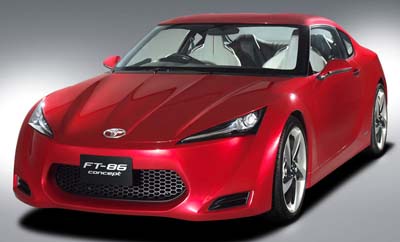
Toyota FT-86 Concept, 2009

Toyota FT-86 Concept, 2009


The Toyota FT-86 Concept is 4,160mm long, 1,760mm wide, and 1,260mm high with a wheelbase of 2,570mm, giving it a compact feeling that is easy for the driver to handle while able to accommodate four occupants. In addition to being light and having a low center of gravity, the Toyota FT-86 Concept boasts the handling of a racing car as well as a 6-speed manual transmission and ADVICS brakes.

The stylish concept captures the heart with the "functional utility" of its highly-refined body. It is the creation of Toyota Europe Design Development known as ED2, which has established body lines that take into consideration a low center of gravity and aerodynamics. The interior is distinctive, featuring an instrument panel with a gray and white base, gauges with red neon lights and digital displays, and a navigation system. In addition, a zipper that evokes an image of interior lapping with minimal covering of a highly-refined body presents a striking display.

It is necessary to create a vehicle in which the driver plays the main role in order to have as many people as possible experience the joy of driving.

The Toyota FT-86 Concept is neither an electric vehicle nor a hybrid vehicle, but is a sports model with a gasoline engine developed to convey the essential appeal of automobiles in a new era. It is a must-see concept car that expresses TMC's desire to once again create a Toyota sports car.

A Small FR Sports Concept Vehicle that Combines Environmental Performance and the Joy of Driving

TMC seeks to develop the ultimate earth-conscious environmentally-considerate vehicle with a focus on hybrid technologies without losing sight of the appeal of cars themselves or the joy of driving.

Over the past several years, the need has been rising for motor vehicles that take into consideration global warming and other environmental issues, while there has also been concern that there have been too few new sports cars that make the heart beat faster and that the time is right for a new generation of sports cars. In response to these needs, TMC has developed the Toyota FT-86 Concept, a sports car equipped with a 2,000cc, horizontally opposed, four-cylinder, naturally-aspirated gasoline engine that evokes the joy of driving a car and the pleasure of vehicle ownership.

As the name "Future Toyota 86 Concept" implies, the Toyota FT-86 Concept, which will be exhibited at the 2009 Tokyo Motor Show, is a new 86 Toyota with a flash red finish. It is a compact, rear-wheel drive sports concept car that embodies speed and the excitement of driving that give cars their appeal as well as environmental performance.

Friday, July 9, 2010

Toyota FT-HS Concept, 2007

Toyota FT-HS Concept, 2007


The Toyota FT-HS hybrid sports concept.

The FT-HS incorporates hybrid capability while maintaining sports car essentials, such as a sleek profile, lightweight aero-dynamic materials, and an advanced high-output powertrain for revolutionary acceleration and optimal performance. This 21st century sports car is fun-to-drive with eco-friendly benefits such as ultra-low emissions and fuel efficiency. The FT-HS appeals to an emerging buyer who grew up eco-conscious and perceives technology as a necessity, not a luxury.

The two-plus-two concept is a front-engine, rear-drive sports car with a projected zero-to-60 acceleration in the four-second range. A powerful V6, 3.5L-engine is coupled with a 21st century sports hybrid system with a target power output of approximately 400-horsepower. At a mid-priced market position, FT-HS would be a true "attainable exotic" with 21st Century performance.

FT-HS expresses the core values of a Toyota Brand design strategy that combines two key elements: J-Factor and Vibrant Clarity. J-Factor refers to the local and global acceptance of Japanese-inspired design and cultural sensibilities. Vibrant Clarity is the design language used to express the J-factor much in the same way that L-Finesse is the language of the Lexus Division. It is the combination of perfect imbalance, freeform geometrics and integrated component architecture. The result of these three elements is subtractive mass, a minimalist style that is not only lightweight, but also looks lightweight.

The exterior design was led by Calty designer, Alex Shen. From a design perspective, the theme of the FT-HS achieves sleek, taut surfaces in its exterior features - especially in the doors and body style. The front and rear have been sculpted to remove mass around key functional components. Freeform geometrics define the integration of fluid surfaces contrasting hard-edge "Aero-Corners" which promote smooth airflow and reduce turbulence.

The roof has a distinctive scooped-out section designed to reduce aerodynamic drag and provide head room at the key areas. Made from carbon fiber Kevlar, the roof retracts so that the roof panel and back window pivot fluidly in a downward motion to stow in the rear seat space.

The vehicle's triangular profile has a floating "C" pillar, aero corners, a full upper-body pan, and innovative open top. A hood features a scalloped channel, exposing the hybrid engine. Integrated component architecture can be seen in the aerospace-inspired lighting. The tail lamp unit spans the entire rear, and has an integrated retractable spoiler. Light-emitting diode (LED) clusters are located in the headlamps and the wing for energy-efficiency and decreased heat loss. Other exterior features include a speed-activated wing that elevates at high speed for additional stability and traction. The rear showcases a carbon fiber lower diffuser with integrated wide exhaust and carbon fiber wheels.

The driver-oriented interior was created by Calty designer, William Chergosky and exudes sleekness, technology, and performance. The lean skeletal look is achieved with exposed cross-car architecture and high-tech materials such as carbon fiber, and titanium. FT-HS' interior features create a dedicated driver's cockpit which include subtractive mass expressions such as cross-car instrument panel structure and delta wing driver pod. The delta-wing driver's pod integrates many useful functions into a lightweight structural unit. All of the important functions and details are presented almost exclusively to the driver. For example, touch-trace sensors which surround the driver and act as tactile guides for finger controls when traveling at high speeds.

By eliminating the "B" pillar and creating a suspended "C" pillar, the minimalist style works in conjunction with subtractive mass. An integrated instrument panel surrounds the driver, creating an enclosed pod effect. Armrests flow seamlessly into the door and surrounding interior.
Seating is optimized for a lightweight appearance and function: the seating accommodates four and then coverts to a two-seater when the roof retracts. The passenger-seat area is open with a simple exposed airbag on the cross-car beam.
A telescoping hub-less steering wheel incorporates semi-automatic paddle shifters and allows the meter to be shifted forward in order to shorten the driver's focus-time between the road and meter, and ultimately enhance driver focus.

TOYOTA FT-HS CONCEPT VEHICLE PRELIMINARY SPECIFICATIONS DRIVETRAIN
3.5 Liter V6 hybrid electric
DIMENSIONS (inches)
* Overall Length: 170.27
* Overall Width: 73.23
* Overall Height: 50.79
* Wheelbase: 104.33
Wheels: Carbon Fiber
Tire Sizes: Front 245/35R21 Rear 285/30R21

Wednesday, May 5, 2010

Toyota FT-86 Concept, 2009

Toyota FT-86 Concept, 2009


The Toyota FT-86 Concept is 4,160mm long, 1,760mm wide, and 1,260mm high with a wheelbase of 2,570mm, giving it a compact feeling that is easy for the driver to handle while able to accommodate four occupants. In addition to being light and having a low center of gravity, the Toyota FT-86 Concept boasts the handling of a racing car as well as a 6-speed manual transmission and ADVICS brakes.

The stylish concept captures the heart with the "functional utility" of its highly-refined body. It is the creation of Toyota Europe Design Development known as ED2, which has established body lines that take into consideration a low center of gravity and aerodynamics. The interior is distinctive, featuring an instrument panel with a gray and white base, gauges with red neon lights and digital displays, and a navigation system. In addition, a zipper that evokes an image of interior lapping with minimal covering of a highly-refined body presents a striking display.

It is necessary to create a vehicle in which the driver plays the main role in order to have as many people as possible experience the joy of driving.

The Toyota FT-86 Concept is neither an electric vehicle nor a hybrid vehicle, but is a sports model with a gasoline engine developed to convey the essential appeal of automobiles in a new era. It is a must-see concept car that expresses TMC's desire to once again create a Toyota sports car.

A Small FR Sports Concept Vehicle that Combines Environmental Performance and the Joy of Driving

TMC seeks to develop the ultimate earth-conscious environmentally-considerate vehicle with a focus on hybrid technologies without losing sight of the appeal of cars themselves or the joy of driving.

Over the past several years, the need has been rising for motor vehicles that take into consideration global warming and other environmental issues, while there has also been concern that there have been too few new sports cars that make the heart beat faster and that the time is right for a new generation of sports cars. In response to these needs, TMC has developed the Toyota FT-86 Concept, a sports car equipped with a 2,000cc, horizontally opposed, four-cylinder, naturally-aspirated gasoline engine that evokes the joy of driving a car and the pleasure of vehicle ownership.

As the name "Future Toyota 86 Concept" implies, the Toyota FT-86 Concept, which will be exhibited at the 2009 Tokyo Motor Show, is a new 86 Toyota with a flash red finish. It is a compact, rear-wheel drive sports concept car that embodies speed and the excitement of driving that give cars their appeal as well as environmental performance.

Toyota Land Cruiser V8, 2008

Toyota Land Cruiser V8, 2008


The new Land Cruiser V8, Toyota's top of the range model, is to make soon its debut on the European market. This eighth generation retains all the world-beating off-road capability of its predecessors but adds more refinement, comfort and superior driving quality.

Land Cruiser chief engineer, Sadayoshi Koyari, explains the development theme of this new generation as follow: "For more than 50 years now three key words have been the basis of each generation of Land Cruiser: strength, durability and reliability. Therefore, rather than opting for revolutionary change, we decided to carry on the sense of trust in the Land Cruiser as the basic concept. With the latest generation we had to recognise the loyalty of Land Cruiser customers by providing a vehicle that will not betray their trust."

Built on a completely redesigned platform with a body-on-frame design, the length of the new model has been increased to 4950mm while the wheelbase has been kept to 2850 mm. The height varies between 1865mm and 1910mm depending on the suspension featured on the model, the width of the model is reaching 1970mm.

The new Land Cruiser will be available with a brand new 4.5 D-4D V8 diesel engine, combined with a new 6 speed automatic transmission, which develops an impressive 650 Nm from 1600 to 2800 rpm and 286 hp at 3600 rpm. This diesel engine has a fuel consumption of 10,2 L/100km, a 4% improvement versus the outgoing 4.2 TD L6 engine, based on the European combined cycle.

The model with an improved 4.7 VVT-i V8 petrol engine, combined with a 5 speed automatic transmission, which develops 445 Nm at 3400 rpm and 288 hp at 5400 rpm. This petrol engine has a fuel consumption of 14.4 L/100km, a 12% improvement, based on the European combined cycle. Both engines are fully compliant with Euro IV emissions regulations.

Advanced new technologies to make new Land Cruiser V8 a genuine, go-anywhere off-road vehicle include:
* The world first Crawl Control system, available in combination with the petrol engine, which automatically controls the engine and the brakes to maintain a very low speed, avoiding spinning and locking. The driver only needs to steer the vehicle when driving in extreme off-road situations.
* The world first 4-Wheel Active Height Control and Adaptive Variable Suspension (4W AHC & AVS), which links all four wheels' suspension system for the first time and also provides a new spring rate control system.
* The European first Kinetic Dynamic Suspension System (KDSS), which actively operates the front and rear stabiliser bars based on a pair of hydraulic control cylinders.
* A newly developed centre Torsen Limited Slip Differential (LSD).

The new model will feature a wide range of advanced safety features like the newly developed Multi Terrain Anti-lock Brake System, the Vehicle Stability Control, the Electronic Brake-force Distribution and 14 Airbags.

Wednesday, February 24, 2010

Toyota Verso

Toyota Verso

The new Toyota Verso is a no-compromise choice for compact MPV customers. It is true to what the term MPV stands for - a multi-purpose vehicle - but doesn't ask the motorist to make sacrifices where style, comfort, quality and driving pleasure are concerned. Combining practicality and safety with desirability, new Toyota Verso will appeal to customers who want and expect more than just a functional car.

New Toyota Verso builds on the strong visual appeal of the model it replaces with a more dynamic design. It also benefits from greater levels of comfort, superior standard safety features, more interior space for passengers and their luggage, and, thanks to an engine range that features Toyota Optimal Drive technology across the board, it gives a more dynamic driving experience while maintaining class-leading emissions levels.

"New Verso has a wide range of interior storage points and user-friendly flexibility that allow it to respond easily to the varying needs of different owners. Handling performance has been enhanced and, with support from our European engineering teams, the vehicle has been fine-tuned to ensure it gives stable and smooth performance on every type of European road."

New Toyota Verso combines modern styling inside and out with space, comfort, practicality and flexibility. Class-leading safety provisions, ride quality, acoustic comfort and dynamic abilities match those of a conventional passenger car.

The interior is all new, with more space, comfort and an improved Easy Flat-7 folding system for the five rear seats that is easier to operate. Special attention has been paid to improving accommodation for all rear seat passengers, while there is significantly more room behind the third row of seats for load carrying.
Toyota Optimal Drive technology has been introduced throughout the range, increasing engine power by up to 20 per cent, while at the same time achieving reductions in emissions and fuel economy of up to 12 per cent. In the UK Toyota Verso will be offered with new 1.6 and 1.8 Valvematic petrol engines which will have a class-leading combination of power and CO2 emissions. These will be offered with a new six-speed manual transmission as standard, with the option of Toyota's new Multidrive S continuously variable transmission on the 1.8 unit. A revised version of the 2.0-litre D-4D diesel will also be available, with a 2.2 D-CAT engine with new six-speed automatic transmission due to join the line-up later in the year.

New Toyota Verso is designed to achieve a maximum, five-star rating in the Euro NCAP crash test programme, thanks to upgraded active, passive and pedestrian impact safety features and a highly rigid, impact absorbing body shell that makes greater use of high tensile steel. Notably all Toyota Verso models will be equipped with curtain shield airbag protection for passengers in the third row of seats and with intelligent steering assist Vehicle Stability Control (VSC+).

Capitalising on an investment of more than €1 billion and reinforcing the Adapazari plant's reputation for exceptional build quality, the car will be built by Toyota Motor Manufacturing Turkey.

The design
Toyota's 'Dynamic Lounge' concept for new Toyota Verso focuses on all the key attributes of a C-segment MPV to ensure the car combines contemporary exterior and interior styling with the ultimate in space, comfort, practicality and flexibility, class leading occupant and pedestrian safety features, and the ride quality, acoustic comfort and dynamic abilities of a conventional passenger car.

The 'lounge' element of the concept can be witnessed in the comfort, quality, convenience, atmosphere and roominess of the all-new interior, while Toyota Verso's 'Dynamic' content is expressed through powerful external and interior design elements and strong driving dynamics.

The exterior
Building on the dynamic character of the current model, new Toyota Verso takes Toyota's design language a stage forward with new Dual-Zone exterior styling.

This approach is expressed in the car's profile view, with a strong character line flowing from the edge of the front bumper, rising through the lower edge of the doors and sweeping up through the C-pillar to the roof-mounted spoiler. On one side of this line Zone I takes in the bonnet and cabin, and on the other Zone II embraces the chassis and boot space.

Front, new Toyota Verso is characterised by forward-flowing lines and a powerful stance, emphasised by the horizontal lines of the twin-bar grille, headlamps that are pulled tightly back into the wings, a deep air dam and a prominent, central Toyota emblem.

In profile view, the sharply delineated front wheelarches complement the dual-zone character line, blending into the upper wings and generating a second character line that runs through the aerodynamic door handles along the vehicle's waistline.

Dimensions have been increased, giving new Toyota Verso a wider and lower stance. Overall length is greater by 70mm at 4,440mm and width is increased by 20mm at 1,790. Overall height remains 1,620mm and the drag coefficient (Cd) of 0.295 is best in the car's class. Toyota Verso remains one of the most compact seven-seat MPVs on the market.

The nterior
Toyota designers describe the interior theme as Smart Wave Dynamism, expressed most strongly in the wave-like form of the upper instrument panel, which distinguishes the functional character of the driver's zone from the more relaxed ambience of the passenger zone. The two zones are linked by a crisp wave line that runs the full width of the fascia.

The speedometer and tachometer are set into individual cylinder housings, angled towards the driver and slightly offset so as not to interfere with the driver's view of the road ahead. The gear lever is mounted close to the steering wheel on a centre console that provides a strong vertical definition of the driver's zone.

New puddle lights are integrated in the door mirrors, which illuminate as you approach and unlock the vehicle with the key fob, with soft orange LED lighting activated in the front footwells as the doors are opened.

Titanium-look inserts are featured on the door handles, steering wheel and centre console and there is a blend of soft-touch technical grain plastic for the upper dashboard, with leather grain effect on the darker, lower section, accentuating the sense of space inside the cabin.

A large panoramic glass sunroof with integrated electric blind is also available, increasing the open and airy cabin atmosphere. It extends from the head of the windscreen to beyond the B-pillars, measuring 1,160mm long and 1,180mm wide. It is the largest one-piece roof of its kind in new Toyota Verso's class. The blind can be opened to any point along the length of the sunroof.

Toyota Easy Flat-7

Toyota Easy Flat-7 allows the five rear seats to be individually folded to carry extra passengers or increase load space as the occasion demands; in all 32 different seating permutations are possible.

In new Toyota Verso Easy Flat-7 has an improved mechanism that returns the second row seatbacks to their original position after being folded to give access to the third row. The headrests on the second and third row seats have a new low-profile L-shape to make the seat folding operation easier and improve rearward visibility from the driver's seat.

The third row seats can now be stowed or erected in one easy action, using just one hand with a pull-strap that can be reached from the tailgate. The third row seatbacks also gain a recline adjustment.

The height-adjustable front seats have better shoulder support and a seat base extended by 20mm to improve comfort, particularly on long journeys, while an increase of 40mm in the height of the front seat cushion gives the driver a better view from the wheel.

Support and cushioning have also been improved for second row passengers and a 30mm increase in the seats' sliding adjustment makes access to the third row of seats easier. The couple distance between the front and second row hip points has been increased by 50mm to a maximum 975mm, creating more rear legroom, and the height of the second row seats has been reduced by 35mm to give more headroom and make it easier for passengers to get in and out of the car.

The boot floor is completely flat when the second and third row seats are folded and is longer by 185mm at 1,830mm, making it easier to load long items. The cargo space is also wider by 240mm at 1,585mm, increasing storage capacity from 63 to 178 litres when all rear seats are in the upright position, compared to the current model. The result is a seven-seat MPV that can carry all passengers in comfort, with ample space for luggage, too.

A new boot management system is located under the rear loadspace, handy for keeping valuable items out of sight or stowing the tonneau cover. Its capacity varies according to how many rear seats are in use, and whether a full-size or space-saver rear wheel is specified.

Generous storage throughout the car also includes a large double-deck glovebox, an overhead console, generously proportioned door pockets, fold-out seatback tables with cupholders, a spacious centre console box, a drawer beneath the front passenger seat, second row underfloor storage and driver and passenger pockets for holding mobile phones or music players.

Noise, Vibration and Harshness
Special attention has been paid to reducing NVH levels in new Toyota Verso to best-in-class levels for a C-segment MPV, comparable to those for many D-segment passenger cars.

As well as using traditional acoustic damping techniques, Toyota Verso marks the world-first application of a two-piece upper and lower liner on the cabin side of the bulkhead. Density of the liner is optimised only at the most critical points to avoid any necessary weight gain. A second acoustic liner on the engine side of the bulkhead combines with under-bonnet insulation to further reduce engine noise intrusion.

Tuned floor silencing panels are installed beneath the seats and in the spare wheel well, and a new acoustic material is used for the first time in a Toyota to insulate and absorb noise in the footwells.

TOYOTA OPTIMAL DRIVE POWERTRAINS
New Toyota Verso benefits from Toyota Optimal Drive, adopting innovative technologies to minimise fuel consumption and CO2 emissions, increase power and maximise driving pleasure.

These diverse core technologies focus on three aspects of powertrain development:
= The reduction of powertrain weight through the use of super-lightweight and highly compact engine components and transmissions.
= The minimisation of mechanical losses through the adoption of Valvematic (a further development of VVT-i), new roller rocker technology, smaller and lighter pistons, low viscosity oil and new six-speed manual and Multidrive transmissions.
= The maximisation of combustion efficiency, achieved by adopting high compression ratios, refinement of intake port and combustion chamber design and the introduction of oil jet piston cooling. All Toyota Verso diesel engines benefit from an upgraded fuel injection system.

Three engines will be available in new Toyota Verso at launch in the UK: two petrol engines, 1.6 and 1.8-litre Valvematic units, which give a best-in-segment combination of power and CO2 emissions; and a revised 2.0-litre D-4D 130 diesel. A 2.2-litre D-4D 150 D-CAT diesel will join the range later in 2009 with a new six-speed automatic transmission.

The new 1.6-litre Valvematic is matched to a new six-speed manual transmission. Compared to the 1.6 VVT-i engine featured in the previous generation Toyota Verso, power has been increased by 22bhp (22 DIN hp) to 131bhp (132 DIN hp), and maximum torque by 10Nm to 160Nm at 4,400rpm. Provisional figures show CO2 emissions down by 17g/km to 161g/km and combined cycle fuel consumption improved from 37.7 to 41.5mpg.

The 1.8-litre Valvematic engine offers the choice of the new six-speed manual gearbox or Multidrive S, Toyota's latest continuously variable transmission technology. It marks significant improvements in power, torque, emissions and fuel economy over Toyota Verso's previous 1.8 VVT-i unit: power is up by 18bhp (18 DIN hp) to 145bhp (147 DIN hp), torque increases by 10Nm to 180Nm at 4,600rpm; CO2 emissions are down 19g/km to 165 g/km (manual), and combined cycle fuel consumption improves from 36.7 to 40.4mpg (provisional CO2 and mpg figures).

With the Multidrive S transmission, CO2 emissions are expected to be 164g/km and combined fuel consumption 40.4mpg, figures which represent the system's advantages over conventional automatic transmissions.

Toyota Verso also gains a revised 2.0-litre D-4D diesel engine that develops a maximum 125bhp (126 DIN hp) and 310Nm from 1,800 to 2,400rpm, with 140g/km CO2 emissions, a best-in-class figure for the core 110-140bhp power range in the seven-seat MPV C-segment.

The 2.2-litre diesel engine featured in the current Toyota Verso range is carried forward for the new model and will be available to UK customers later in 2009. Output is increased to 148bhp (150 DIN hp), and maximum torque up to 340Nm, available from 2,000 to 2,800rpm. Equipped with Toyota D-CAT clean diesel technology, it produces 178g/km of CO2 and returns 41.5mpg in combined cycle driving (provisional figures). This engine will be matched to a new six-speed automatic transmission.

Ride and Handling
New Toyota Verso has been designed to give the agile handling, body control, stability and ride comfort of a conventional passenger car with its all-new high-rigidity body shell, longer wheelbase, wider front and rear tracks and extensively revised suspension geometry.

Aerodynamics
New Toyota Verso has a class-leading drag coefficient of 0.295 thanks to a carefully judged design that is fundamental to the car's body control, high speed stability and reduction of wind noise.

Particular attention has been paid to the flow of air beneath the car, with a smooth underfloor, wheel spats and wing-shaped vertical fins contributing to the control of vertical body movement and optimisation of front and rear lift coefficients. The result is a flatter straight-line ride, more controlled yaw response and better rear stability, notably in cross-winds.

Suspension
The MacPherson-type front suspension has a new set-up with dual top mounts: a stiffer, outer mount locating the spring and a softer inner mount locating the damper. With increases in the caster angle and roll rigidity, the new format gives optimum handling with low noise transmission and excellent ride comfort.

The compact, lightweight rear torsion beam with integrated anti-roll bar has also been revised with adjustment to trailing arm angle to improve steering response. The spring and damper mounts have been separated to improve packaging efficiency, ride comfort and handling.

Electric Power Steering
For the first time in Europe, Toyota has added active steering force compensation to its variable assistance Electric Power Steering in new Toyota Verso. If the system detects a steering input speed that is too high for the required vehicle response, it will automatically reduce power assistance delivery to limit the input and so promote smoother driving.

When the steering column torque sensor detects vibration from the wheels, an active vibration control programme with the ECU can produce a compensating signal to reduce the vibration before it reaches the steering wheel.

Brake and Tyres
New Toyota Verso is equipped with the latest ABS and VSC+ braking and stability systems, incorporating electronic Brakeforce Distribution (EBD) and Brake Assist (BA) to give much shorter stopping distances.

Safety
New Toyota Verso benefits from upgraded active, passive and pedestrian impact safety features and has a highly rigid, impact-absorbing body shell with a higher proportion of high tensile steel. These elements are designed to earn it a top five-star rating in the new, more stringent Euro NCAP crash test programme.

Active Safety
A full range of active safety systems are available for new Toyota Verso, including the latest-generation ABS with Electronic Brakeforce Distribution (EBD) and Brake Assist (BA).

The intelligent steering assist VSC+ system, fitted as standard, counteracts under or oversteer by independently applying braking force to any of the four wheels, while simultaneously generating counter-steering torque to help the driver bring the car under control. Traction Control (TRC) contains wheelspin and Steering Torque Assist counters vehicle yaw moments under braking or acceleration.

Hill-start Assist Control (HAC) provides extra control when pulling away on a gradient, preventing the vehicle from rolling backwards.

Passive Safety
Seven airbags are fitted as standard: driver front passenger front and side airbags, front passenger knee airbag; and curtain shield airbags that extend the full length of the cabin to protect occupants in both rows of rear seats - a feature that is rare in the compact MPV segment.

The front seats have active anti-whiplash headrests and all seats are linked to a seatbelt reminder system on the instrument panel. Further protection against leg injuries is provided for driver and front passenger by energy-absorbing pads built into the front footwells.
Side impact forces are channelled across the floorpan and through roof strengthening members and, in a first for a Toyota vehicle, energy absorbing pads are located on the door belt line and rear passenger hip point to reduce injuries.

A high-resistance seat rod is positioned beneath the rear seats and secured on each side of the cabin, further helping to absorb side impacts.

Pedestrian Impact Safety
New Toyota Verso's bonnet has an energy-absorbing structure and a crushable cowl at its rear edge. The wiper motor and linkage have been relocated lower down on the firewall, further away from the point of impact should a pedestrian be hit.