Showing posts with label Aston Martin. Show all posts

Wednesday, October 10, 2012

Aston Martin V8 Vantage S, 2012


  •  Aston Martin V8 Vantage S, 2012

The Aston Martin Vantage range comes of age with the new Aston Martin V8 Vantage S characterised by a host of new driver-focussed features all designed to push the honed dynamics of the standard Vantage to a new benchmark level.

Aston Martin's own 4.7 litre V8 engine has been engineered to deliver peak power of 430 bhp (436 PS / 321 kW) at 7300 rpm and torque of 490 Nm (361 lb.ft) at 5000 rpm and is coupled with a new ground-up developed Sportshift™ II transmission specifically designed for the Aston Martin V8 Vantage S with seven short ratio gears to deliver the most engaging and intense driver involvement.

Dynamic revisions are central to the Vantage S, with a quickened steering rack ratio of 15:1 compared to 17:1 on the standard car and a larger diameter front brake disc with new six-piston front brake calipers. New springs and dampers, and wider rear wheels also contribute to chassis revisions. A new dynamic stability control (DSC) system specifically tuned to the Aston Martin V8 Vantage S along with a new brake module providing features such as Hydraulic Brake Assist (HBA) which provides assistance in emergency braking situations, and Hill Start Assist (HSA). Bespoke tyres have been developed with Bridgestone to optimise road holding enhancing dynamic feel.

At the core of the Aston Martin V8 Vantage S is the new seven speed Sportshift™ II automated manual transmission, offered as standard and delivers exceedingly rapid gear changes, twenty per cent quicker than Sportshift™. The extra gear permits shorter well-spaced ratios taking advantage of the optimum torque, which combined with a shorter final drive ratio of 4.182:1 delivers quicker acceleration and an enhanced sporting feel. The inherent benefits of a single clutch system reduces complexity and significant weight over a dual clutch solution. Sportshift™ II allows the driver to take an increased level of control, modulating the throttle pedal to achieve the desired type of gear change. In addition, the Vantage S features a 'Sport' button which quickens the gear changes and gives the driver a more aggressive throttle response while also opening the exhaust bypass valves across most of the engine speed range perfectly characterising the 'S' variant.

As with every Aston Martin, the Aston Martin V8 Vantage S benefits from its own unique sound with a new exhaust muffler and bypass valve map, creating a very distinctive and highly vocal exhaust note.

The Aston Martin V8 Vantage S is instantly recognisable as a true Aston Martin, characterised by its purposeful stance conveying its agility and performance capability. From the front, a new lower front bumper finished in perfectly-aligned carbon fibre houses a larger air intake feeding the engine and front brakes. The splitter combined with the extended deck lid 'flip' work in harmony to provide increased down force at speed. New 19 inch 'V' spoke wheel styles are available as standard, while an optional 10-spoke lightweight forged wheel option, reduces unsprung mass further. A new rear bumper and side sills optically widen the car.

Bridging the gap between road car and race car, the Aston Martin V8 Vantage S is heavily influenced by the 2011 Vantage GT4 race car. The GT4 takes advantage of the Vantage's immensely rigid bonded aluminium chassis, providing the ideal platform for a race car. Minor racing safety modifications including an FIA approved roll cage and racing 'bag' petrol tank along with weight saving measures are made to the standard road car to convert it into a class winning race car. In 2010, it won its class at the Dubai 24 Hours following this up with further endurance race wins at the Nürburgring 24 Hours, Silverstone 24 Hours and Spa 24 Hours. It also won its first major international championship victory in the European GT4 Cup.

Performance
The rationale behind the Aston Martin V8 Vantage S was to push the boundaries of the already acclaimed V8 Vantage with the highest levels of driver involvement possible. Aston Martin engineers set about enhancing nearly every dynamic element of the car to create a highly distinctive driving experience.

The 4.7 litre V8 engine has been modified to deliver peak power of 430 bhp (436 PS / 321 kW) at 7200 rpm and torque of 490 Nm (361 lb.ft) at 5000 rpm representing an increase of 10 bhp and 20 Nm respectively and is signified with a black engine plenum. The increase has been achieved through a valved air intake system and an aggressive spark strategy. The air intake system valve opens above 3500 rpm to allow more air to flow into the engine, which helps optimise performance at precisely the right part of the torque curve. Aggressive spark strategy uses sophisticated electronics to ignite the fuel in the engine at precisely the right time allowing it to run at its most powerful. It can also recognise higher octane fuel and extract the optimum performance from the increased rating.

The power and torque delivery on the Aston Martin V8 Vantage S is delivered at the most frequently used mid range engine speeds which creates tractable and effortless acceleration. Most demand for power and torque is in the mid-range which on the Aston Martin V8 Vantage S is where the greatest torque is delivered at 5000 rpm.

Sportshift™ II is an automated manual transmission featuring a new seven speed Graziano gearbox which is positioned at the back of the Aston Martin Vantage S on the transaxle contributing to 49:51 near perfect weight balance. The system benefits from a single manual clutch mated with electronic switching gear to change ratios and was designed from the ground-up exclusively for the Aston Martin V8 Vantage S. Aston Martin specifically chose to develop the SportshiftTM system owing to its inherent sporting benefits including mass saving, low complexity of moving parts, and real tangible gear changes. This contributes, along with other weight saving parts, to a total vehicle weight reduction of 30 kg.

Electro-hydraulic controls are actuated via two steering column mounted magnesium paddles allowing the driver to shift up or down. Quicker than a conventional manual system, and at least 50kg lighter than a dual clutch system, Sportshift II offers the inherent benefits of being able to drive in automatic mode as well as shifting manually. Sportshift II is 24kg lighter than Sportshift™ featured on the standard Vantage.

Sportshift II features seven ratios allowing the first six gears to sit closer together taking advantage of the engine's torque characteristic; this enhances the acceleration feel and gives the driver increased control. The seventh gear is a longer ratio delivering a quieter, more refined cruising gear for motorway stretches and also delivers increased fuel economy.

Driver interaction with SportshiftTM II is made as simple as possible to allow the driver to concentrate on the road ahead. Two magnesium paddles allow an up or a down shift through the gears. The controls are column-mounted so that the driver can always locate them with ease no matter what position the steering wheel is in.

As well as selecting gears manually with the paddle-shift, the driver is also able to select the 'D' button on the facia to engage automatic mode which acts like a traditional automatic gearbox changing gear at precisely the right time, making light work of urban, traffic and motorway driving.

The new seven speed automated manual is standard on the Aston Martin V8 Vantage S perfectly suiting the sporting nature of the car. Aston Martin has opted not to offer a manual transmission option owing to the high expected demand of Sportshift™ II.

The Aston Martin V8 Vantage S' sporting character really comes into its own when the 'Sport' button on the facia is depressed giving the driver faster gear changes in both manual and automatic (a decrease of 60 milliseconds) and prevents the car changing up to the next gear when the revolution limit is reached. The default 'normal' provides a more progressive, throttle response, suited to more everyday situations, such as driving in urban areas, heavy traffic, or in challenging weather conditions. Selecting 'Sport' mode delivers a sharper throttle response together with a sportier exhaust note. This mode is designed for use in more dynamic driving situations where sharper responses are required, extracting the maximum performance from the car.

The Aston Martin V8 Vantage S weighs 1610 kg, (coupe), 30 kg lighter than the standard Vantage owing to weight optimisation of the new Sportshift™ II transmission and use of carbon fibre. Air cooled, rather than oil cooled, the Sportshift II system takes advantage through the deletion of the oil pump and associated ancillaries saving 24 kg over the conventional six speed Sportshift system.

As with all Aston Martins, the Vantage S benefits from near perfect weight balance of 49:51 front to rear owing to the placement of the gearbox on the transaxle contributing to the excellent dynamics.

The Aston Martin V8 Vantage S remains a practical day to day sports car featuring a 300 litre boot with convenient tail gate opening in coupe guise, while the Roadster has an automatically retracting fabric hood which can be operated up to 30 km/h.

The S variant features a unique exhaust muffler specifically tuned to aurally define its sporting intent. A revised map opens the bypass valves earlier in the rev range at 3500 rpm and even earlier in 'Sport' mode producing more crackle on the overrun.

Control
The Aston Martin V8 Vantage S bridges the gap between the V8 Vantage and the Vantage GT4 endurance race car offered by Aston Martin Racing. The standard components of the Vantage platform lend themselves perfectly to competition and produce a race-fit car with only minor modification. 2010 was the most successful year yet setting the Vantage as the benchmark GT4 competition car: it won its class at the Dubai 24 Hours following this up with further endurance race wins at the Nürburgring 24 Hours, Silverstone 24 Hours and the Spa 24 Hours. However, it was the car's first major international championship victory in the European GT4 Cup with Rhesus Racing that was the crowning of an excellent year for the car. In 2011, the Vantage GT4 was updated to take advantage of the increased aerodynamic benefits of the V12 Vantage and V8 Vantage S' body styling.

With knowledge from the track filtering into Aston Martin's road cars and the ease of driving them filtering onto the race track, the Aston Martin V8 Vantage S benefits from having its handling characteristics honed by the marque's knowledgeable and talented engineers.

The steering rack has been modified with a ratio of 15:1 compared to 17:1 on the standard Vantage lowering the number of steering wheel turns lock-to-lock from 3.04 to 2.62. This results in greater precision and improved agility, response and fluidity of handling, and allows the driver to feel a closer connection to the car - delivering a more engaging and energetic drive.

An upgraded braking system plays a central role to the Aston Martin V8 Vantage S' dynamics, with a new larger diameter front brake disc, 380mm compared to 355mm on the V8 Vantage, six piston front calipers and a new generation of brake control module.

The front brakes are a racing-inspired floating disc design. The discs are made from two materials: cast iron and aluminium; the cast iron is bolted via a floating bobbin system to the aluminium bell. The technology provides dynamic advantages in the form of reduced unsprung mass with a brake that is lighter than a standard cast iron brake, has better thermal stability, improved cooling and produces a more consistent pedal feel. Despite the front disc being of a larger diameter, the weight of each disc has been reduced by 0.4 kg. The Vantage S also features a new brake 'booster' reducing pedal effort and travel.

The system features a new braking module delivering more discreet interventions and provides improved functionality for existing features such as ABS, Dynamic Stability Control (DSC), Electronic Brakeforce Distribution (EBD), Traction Control (TC) and Positive Torque Control (PTC) as well as the new Hydraulic Brake Assist (HBA), which provides assistance in emergency braking situations. The Hydraulic Brake Assist function identifies when the driver requires maximum braking performance, from the speed at which the brake pedal is depressed, and automatically boosts the brake pressure up to the ABS control threshold for as long as the driver keeps the brake pedal pressed down. As a result, stopping distances can be substantially reduced.

Tuesday, September 25, 2012

Aston Martin V8 Vantage, 2012


  • Aston Martin V8 Vantage, 2012

The Aston Martin Vantage range continues to evolve with a comprehensive array of improvements to the Aston Martin V8 Vantage aimed at enhancing the dynamic feel, style and competitive pricing of the marque's entry-level sports car. There are also changes at the top-end of the Vantage range with the new and ultra-exclusive V12 Zagato assuming the role of flagship when it enters production later in 2012.

In the most comprehensive programme of enhancements since 2008, the revised 4.7-litre 420bhp (426PS/313kW) entry-level Aston Martin V8 Vantage features a raft of improvements first seen in the critically acclaimed Vantage S. The standard six-speed manual transmission remains, but the optional six-speed Sportshift™ automated manual transmission has now been replaced with the seven-speed Sportshift™ II. With an additional gear, closer ratios, lower final drive and a quicker, refined shift quality, this new gearbox - designed and manufactured specifically for Aston Martin - provides faster and more precise shifts, optimises acceleration and delivers a sporting driving experience.

Further dynamic enhancements centre on the Aston Martin V8 Vantage's chassis, which features developments from the Vantage S. Quicker steering, bigger brakes and wider tyres have all been fitted to further enhance the Aston Martin V8 Vantage's class-leading poise and make it even more responsive and exciting to drive. A new steering column installation, re-valved power-steering pump and a quicker ratio of 15:1 compared to 17:1 on the previous model ensure the new V8 Vantage steers with even greater precision, handles with more agility and provides more feedback for a completely engaging drive.

Stopping power and pedal feel have been significantly increased thanks to new 380mm two-piece ventilated cast-iron front discs and six piston callipers. This new braking system also includes Hill Start Assist (HSA) for more precise control on steep inclines. The Aston Martin V8 Vantage also comes with tyres that are 10mm wider than the outgoing model. Not only does this increased contact area improve the V8 Vantage's already prodigious levels of road-holding, but it allows the more responsive steering and stronger brakes to be fully exploited.

To reflect its enhanced performance the Aston Martin V8 Vantage has received a number of styling changes inspired by the Vantage S and N400 limited edition. At the front a lower bumper - complete with aerodynamic splitter - houses a larger air intake that feeds the engine and front brakes. At the rear a diffuser creates added drama and function, while sculpted race-derived side sills complete the V8 Vantage's more muscular look.

These technical and styling changes have been applied to both the Aston Martin V8 Vantage Coupe and Roadster models, with prices starting from £84,995 / €108,500 (Germany).

The £99,995 / €128,500 (Germany) Vantage S remains the most generously equipped, highest performing and most driver-focussed V8-engined model in the range. Developing 430bhp (436PS/321kW) at 7300rpm and 490Nm (361lb ft) of torque at 5000rpm the Vantage S's more potent state of engine tune perfectly complements the Sportshift™ II close-ratio seven speed automated manual transmission, which is fitted as standard. A sports exhaust system unique to the 'S' further emphasises its sporting credentials, delivering a rousing soundtrack, totally in keeping with the intensity of the driving experience.

Carbon fibre detailing of the Vantage S's motorsport-derived aerodynamic package makes a discreet and highly appealing visual distinction from the V8 Vantage, while inside the 'S' variant features a sumptuously trimmed interior that demonstrates Aston Martin's unique ability to combine the craftsmanship of traditional hand-stitched leather upholstery with striking modern design. The company's fully integrated satellite navigation system developed in conjunction with Garmin is now fitted as standard along with Bluetooth and cruise control.

Production of the sensational V12 Vantage continues unchanged; this acclaimed model delivering its unrivalled blend of extreme performance, exclusivity and practicality in one unique package. Powered by a 6.0-litre V12 engine producing 510 bhp (380 kW / 517 PS), and 570 Nm (420 lb ft) of torque, this remarkable evolution of the Vantage has a top speed of 190 mph (305 km/h) and 0-62 mph (0-100 kp/h) time of 4.2 seconds while its uniquely thrilling character distinguishes it from the rest of the range.

The Vantage range will be joined by the exotic V12 Zagato, created in 2011 to celebrate the 50th anniversary of the iconic DB4GT Zagato. A prototype V12 Zagato caused a sensation by winning the prestigious Villa D'Este concours and competing in the Nürburgring 24-hour race. Now, less than 12-months after its dramatic debut, the V12 Zagato - employing a unique blend of bespoke Italian design, hand-built craftsmanship and advanced technology - is poised to enter strictly limited production, with first deliveries to commence later this year.

Racing is in Aston Martin's DNA and the Vantage is at the forefront of Aston Martin's motorsport activity. The Vantage first went racing in 2006, when Aston Martin's CEO Dr Ulrich Bez and members of the company's engineering department took a near-standard Aston Martin V8 Vantage to the gruelling Nürburgring 24 hour race. Since then GT4 versions of the V8 Vantage have become a force to be reckoned with, spawning one-make race series and winning their class in Dubai, Nürburgring, Silverstone and Spa 24-hour races. For 2012 Aston Martin Racing is stepping up a gear with the new V12 Vantage focused race car. Currently undergoing an extensive test programme this spectacular new racing car will be in action throughout the 2012 season.

Combining iconic styling, thrilling performance, true craftsmanship and exclusivity the revitalised Vantage range boasts unprecedented breadth and appeal. The revised Aston Martin V8 Vantage together with the rest of the range is available to order now from Aston Martin's global dealer network.

Saturday, September 15, 2012

Aston Martin Cygnet, 2012


  •  Aston Martin Cygnet, 2012

The Aston Martin Cygnet is a city car that sets a new benchmark for compact luxury, building upon nearly a century of experience building high performance sports cars, luxurious long-range grand tourers, and extremely competitive racing machines.

Cygnet demonstrates Aston Martin's commitment to innovation and integrity. "It is time to think differently. Aston Martin is honest and we don't make compromises" says Aston Martin CEO Dr Ulrich Bez.

The Aston Martin Cygnet expresses a simple but fundamental idea: in the modern city, scale equates to speed and freedom. At just three metres long, the Cygnet gives the driver a new dimension of freedom, able to slot into gaps in traffic, exploit the smallest parking spaces, consume the least fuel and emit the lowest emissions, all while delivering exceptional levels of quality and comfort.

Cygnet is a product of Aston Martin's unrivalled experience in craft, technology and design. The future city will present a very different luxury brand landscape, as social change and legislation increases the division between urban and anti-urban product categories. With the Cygnet, Aston Martin will be at the forefront of these changes, ensuring the company's enduring brand image will continue to prosper in new market conditions.
The Cygnet, a tailor fit solution for the city, help drive Aston Martin into the future. "This car is reality; Cygnet is the natural choice for those who want a premium, bespoke commuter car."

The Cygnet will be the eighth major production car Aston Martin has introduced at its state-of-the art factory since 2004, offering further evidence of the company's ongoing commitment to British manufacturing, backed-up by a dedicated local workforce and supplier network.

Saturday, April 14, 2012

Aston Martin DBS Volante, 2010


Aston Martin DBS Volante, 2010

Aston Martin DBS Volante makes its debut at the 2009 Geneva Auto Salon. Completing the Aston Martin DBS line-up, the new Volante will afford customers the combination of the DBS's already-established benchmark sports car characteristics with all the thrills of open-air motoring.

Broadening the DBS's character, the Aston Martin DBS Volante will appeal to drivers who wish to combine the excitement of driving a finely-tuned sports car with the invigorating feeling of being open to the elements. This juxtaposition of ultimate performance and openness stirs the senses on any drive whether an exhilarating jaunt on favoured roads or cruising on lengthy journeys. 'Volante', meaning 'moving with light rapidity', perfectly defines the performance potential and the dynamic characteristics of the Aston Martin DBS Volante.

Featuring a motorised retractable fabric roof, the DBS's beautiful profile is preserved whether up or down. When the roof is closed, it provides a warm comfortable ambience and when open, it neatly disappears behind the new tonneau cover at the touch of a button.

Conceived as a Volante from the outset, Aston Martin engineers opted for a fabric hood to closely follow the silhouette of the DBS coupe and due to its lightweight properties, minimise overall weight gain. Fully retractable in only 14 seconds and at up to speeds of 30 mph (48 km/h), the roof will automatically stow under the newly sculpted tonneau, maintaining the Aston Martin DBS Volante's perfect form - hood up or down.

Power is provided by Aston Martin's hand-built all alloy 6.0-litre V12 engine producing 510 bhp (380 kW / 517 PS), and 570 Nm (420 lb ft) of torque with a top speed of 191 mph (307 km/h) and 0-62 mph (0-100 km/h) time of 4.3 seconds. The nature of the V12, and in particular the torque available at all engine speeds, serves to provide effortless driving in all situations.

Aston Martin's 16th convertible in 95 years, the Aston Martin DBS Volante draws on the marque's extensive experience in designing iconic 'Volantes' and is a 2+2 featuring two occasional rear seats, ideal for young people or extra luggage. In standard specification, the DBS has a rear-mounted six-speed manual gearbox, while an automatic six-speed 'Touchtronic' option is also available. As with the coupe, the Volante is offered with carbon ceramic brakes as standard providing exceptional stopping power. Benefitting from materials derived from the motorsport and aerospace industries, the bonnet, front wings and boot lid are made from carbon fibre all helping to reduce weight.

The Aston Martin DBS Volante also comes with Bang & Olufsen's renowned 'BeoSound DBS' in-car entertainment system, featuring 13 speakers as standard equipment. The BeoSound DBS has been expertly tuned by Bang & Olufsen's Tonmeisters and Aston Martin's acoustic engineers specifically for the Volante resulting in a system that senses when the roof has been retracted and adjusts the sound stage to compensate for extra wind noise, providing an unrivalled automotive audio experience.

Design
Although the DBS was originally conceived as a two-seater sports GT, the potential for a Volante version was always in the minds of the design team. Holding a purposeful stance, the muscular shapes and forms of the DBS have been retained exuding confidence.

Aston Martin's 16th convertible, learning taken from the engineering of previous soft-top cars has resulted in the Aston Martin DBS Volante possessing Aston Martin's quietest and most refined roof system to date. When raised, the fabric roof is insulated with a layer of Thinsulate® material relieving cabin noise and protecting the inhabitants from the elements. The hydraulic pump has been cocooned in a noise and vibration enclosure reducing noise when raising and lowering the hood.

The newly choreographed hood has resulted in an opening time of only 14 seconds due to a new five-piston hydraulic pump. The roof effortlessly stows below the newly-sculpted tonneau cover which has been redesigned to enhance the muscular attributes of the Aston Martin DBS Volante. Housing the Roll-Over-Protection-System (ROPS) which deploys two roll bars in the event of the car rolling over, the rear humps lead your eye to the new carbon fibre deck lid which has been re-styled for the Aston Martin DBS Volante. Particular to the DBS, a line flows from the leading edge of the bonnet past the elegantly sloped windscreen flowing into the carbon fibre deck lid and to the rear boot 'flip'.

As with the DBS Coupe, the bonnet, front wings and boot lid are formed from carbon fibre. Preventing the weave protruding the paint finish, Aston Martin employs a patented 'surface veil' technology applying a 200 micron thick layer of epoxy glue to the carbon fibre, before the application of seven layers of paint producing a class A level of finish.

The interior of the DBS represents the epitome of Aston Martin's commitment to using materials honestly, without disguise or embellishment. Lightweight materials are used throughout to save weight; door pulls are made from carbon fibre, for example, and the carpet has been woven with lighter fibres to save valuable kilograms.

The Volante features 2+2 seating as standard. The beautifully leather trimmed rear seats are ideal for younger persons or extra luggage making the Aston Martin DBS Volante a practical everyday sports car.

Delivered as standard with Bang & Olufsen's BeoSound DBS audio system and seamlessly integrated into the Aston Martin DBS Volante's bespoke interior, the system provides the driver and passengers with an unrivalled audio experience. Consisting of 13 individual speakers and Bang & Olufsen's unique Digital Signal Processing system, the system transforms the Aston Martin DBS Volante into an acoustically sophisticated venue, capable of conveying subtle and striking musical dynamics from every source. The BeoSound DBS has been specifically revised for the Aston Martin DBS Volante and senses when the roof is up or retracted and adjusts the sound stage to compensate for wind noise and change in acoustics.

The Bang & Olufsen BeoSound DBS system has been developed exclusively for Aston Martin. The system is acoustically and physically matched to the Aston Martin DBS Volante, with a design that follows the inherent quality and material honesty of the Aston Martin interior. The loudspeaker grilles are finished with smoothly contoured aluminium so as to integrate seamlessly with the fluid lines and curves of the cabin. When the system is turned on, the twin acoustic lens speakers emerge silently and swiftly, adding a touch of theatre and technological panache that is the perfect complement to the Aston Martin DBS Volante.

As with the coupe, the Volante affords customers the prospect of specifying the optional 10-spoke 20" forged aluminium lightweight wheel with diamond-turned surface - available in either silver or graphite finishes. With an overall unsprung mass reduction of 8 kg, the option aids enhanced handling, improved acceleration, and braking performance.

Performance
The need for high-performance stability, handling ability and low kerb weight defined the DBS's form and construction. The Aston Martin DBS Volante is powered by the same 6.0-litre V12 engine at the heart of the DBS which was launched in 2007. Producing 510 bhp (517 PS / 380 kW), peak power is delivered at 6500 rpm and the 570 Nm (420 lb ft) of torque is delivered at 5750 rpm. Tractable at any time, the DBS possesses a 'flat' torque curve providing 85% of the torque from 1500 rpm.

The 3.71:1 (manual) and 3.46:1 (Touchtronic) final drive ratio assures that all the Aston Martin DBS Volante's power is useable, while also enhancing in-gear acceleration.

Adding to the sonorous V12 enhances the aural soundtrack. Special by-pass valves in the exhaust allow a quieter exhaust note at low speeds; at 4000 rpm these open to reduce the pressure in the exhaust system, raising the power output as well as generating a rousing aural accompaniment.

The Aston Martin DBS Volante is available as standard with a rear-mounted 6-speed manual gearbox with gear ratios optimised to extract the very best from the 6.0-litre engine. Providing customers with even greater personalisation capabilities, a 'Touchtronic' 6- speed automatic featuring a torque converter is also available as an option.
Derived from the same ZF transaxle unit that was developed for the Aston Martin DB9, the system has been substantially re-engineered to accommodate the power and performance characteristics of the DBS.

System functionality is consistent with that on the DB9, with 'Park', 'Reverse', 'Neutral' and 'Drive' modes selected via facia mounted controls.

When in 'Drive' mode, pulling either of the leather-trimmed magnesium alloy paddles mounted on the steering column will activate Touchtronic mode, enabling the driver to control gear shifts via the paddles. Touchtronic mode is also accessible directly on engine start-up. Alternatively, the 'Drive' mode can be selected at any time by pressing the 'D' control on the centre console, engaging a fully automatic mode which will select the most appropriate gear for the speed and driving conditions automatically.

The system also includes a 'Sport' mode - activated by a button on the centre console - which engages a more aggressive gear shift strategy as gear changes feel sharper and more forceful, engine speed matching on downshifts is more aggressive and in full automatic mode, upshifts occur at higher speeds. The Sport setting also incorporates a more responsive throttle map to match the high-performance characteristics of the Aston Martin DBS Volante.

Control
Contributing to the class-leading levels of rigidity, the VH-platform (Vertical - Horizontal) upon which all Aston Martins are founded, ensures a dynamically accomplished convertible translating into an exciting and communicative chassis. The VH architecture is a bonded aluminium structure that provides outstanding strength and rigidity. In comparison to its coupe sibling, the Volante retains 75% of the rigidity equating to 20kNm per degree. This has been achieved by rigidly mounting the rear sub frame and optimising the front and rear shear panels. Working together these components contribute to more than 20% of the total torsional rigidity.

Augmenting the Aston Martin DBS Volante's supreme handling characteristics is the near perfect weight distribution - achieved by mounting the 6-speed gearbox at the rear placing 85% of the weight between the front and rear axle.

To take full advantage of its extremely precise and rigid platform, the DBS employs a sophisticated Adaptive Damping System (ADS) which is specifically tuned for the Aston Martin DBS Volante maximising ride comfort. It uses two separate valves to set the dampers to five different positions, allowing instant adjustment of the car's ride and handling characteristics. The ADS automatically alters the suspension settings to ensure the driver has high levels of control at all times, with the ability to respond instantly to different driving conditions. The dampers can be 'softer', with a corresponding improvement in ride quality, or 'firm', providing improved body control for more spirited driving.

The damper settings are determined by an electronic control unit which takes sensor readings from the car's systems, including throttle position, brake position, steering wheel rotation and vehicle speed. This data establishes the prevailing driving conditions and the demands the driver is making on the car.

The Aston Martin DBS Volante's Adaptive Damping System perfectly captures the car's sporting character, ensuring that stiffer dampers are available for better handling and control when the car is being driven enthusiastically, without compromising ride comfort during 'normal' driving conditions. A designated 'Track' mode automatically sets all dampers to their firmest positions, making it ideal for circuit driving. The DBS Volante is fitted with Pirelli P-Zero tyres that have been developed especially for the car.

The Aston Martin DBS Volante also has a revised Dynamic Stability Control (DSC) system specifically tuned to the Volante to help maintain maximum traction in challenging driving conditions. In default operation, the DSC is automatically on. Select and press the button for two seconds and DSC 'Track' mode is engaged, raising the threshold at which the system intervenes to allow the experienced driver to explore the car's limits. Hold the button for four seconds and DSC is disengaged entirely.

Carbon Ceramic Matrix (CCM) brakes are featured as standard. Providing shorter stopping distances with excellent resistance to fade in even the most demanding driving conditions, the CCM brakes are some 12.5 kg lighter than a conventional system. This results in reducing the overall weight of the car and, in particular, the unsprung weight and rotational masses, further enhancing the Aston Martin DBS Volante's dynamics.

Technical Specification
    * Body
          o Two-door convertible body style with 2+2 seating
          o Bonded aluminium VH structure
          o Aluminium, magnesium alloy and carbon-fibre composite body
          o Extruded aluminium door side-impact beams
          o High Intensity Discharge (HID) headlamps (main beam)
          o LED rear lamps and side repeaters
    * Engine
          o All-alloy, quad overhead camshaft, 48-valve, 5935 cc V12
          o Compression ratio 10.9:1
          o Front-mid mounted engine, rear-wheel drive
          o Fully catalysed stainless steel exhaust system with active bypass valves
          o Max power: 380 kW (510 bhp / 517 PS) @ 6500 rpm
          o Max torque: 570 Nm (420 lb.ft) @ 5750 rpm
    * Performance
          o Acceleration: 0-100 km/h (0-62 mph) in 4.3 seconds
          o Max speed: 307 km/h (191 mph)
    * Transmission
          o Rear-mid mounted, six-speed manual gearbox. Rear-mid mounted 'Touchtronic 2' six-speed gearbox with electronic shift-by-wire control system
          o Alloy torque tube with carbon fibre propeller shaft
          o Limited-slip differential
          o Final-drive ratio 3.71:1 (manual) 3.46:1 (Touchtronic)
          o Wheels and Tyres
          o Front: 8.5" x 20" Pirelli P Zero 245/35
          o Rear: 11" x 20" Pirelli P Zero 295/30
    * Steering
          o Rack and pinion, Servotronic speed-sensitive power-assisted steering, 3.0 turns lock-to-lock
          o Column tilt and reach adjustment
    * Suspension
          o Front: Independent double wishbone incorporating anti-dive geometry, coil springs, anti-roll bar and monotube adaptive dampers
          o Rear: Independent double wishbones with anti-squat and anti-lift geometry, coil springs, anti-roll bar and monotube adaptive dampers
          o Adaptive Damping System (ADS) with Track mode
    * Brakes
          o Front: Ventilated carbon ceramic discs, 398 mm diameter with six-piston callipers
          o Rear: Ventilated carbon ceramic discs, 360 mm diameter with four-piston callipers
          o Dynamic Stability Control (DSC) with Track mode
          o Anti-lock Braking System (ABS)
          o Electronic Brakeforce Distribution (EBD)
          o Emergency Brake Assist (EBA)
          o Traction control
    * Dimensions
          o Length: 4721 mm (185.9")
          o Wheelbase: 2740 mm (107.9")
          o Width:
                + 1905 mm (75") (exc. Mirrors)
                + 2060 mm (81.1") (inc. Mirrors)
          o Fuel tank capacity: 78 litres (17.2 Imp.galls, 20.5 US galls)
          o Height: 1280 mm (50.4")
          o Weight: 1810 kg

Equipement
    * Interior
          o Full grain leather interior
          o Matrix alloy facia trim and Iridium Silver centre console surround
          o Carbon fibre door trims and door pulls
          o Auto-dimming rear-view mirror & garage door opener (USA & Canada only)
          o Sports seats with electric adjustment
          o Memory seats & exterior mirrors (three positions)
          o Dual-stage driver/passenger front airbags
          o Side airbags
          o Heated seats
          o Heated rear screen
          o Automatic temperature control
          o Organic Electroluminescent (OEL) displays
          o Trip computer
          o LED map lights
          o Cruise control
          o Hard Disk Drive (HDD) satellite navigation system
          o Bluetooth telephone preparation
          o Powerfold exterior mirrors
          o Front and rear parking sensors
          o Tyre-pressure monitoring
          o Alarm and immobiliser
          o Remote-control central door locking and boot release
          o Wind deflector
          o Battery disconnect switch
          o Battery conditioner
          o Tracking device (UK only)
          o Boot-mounted umbrella
          o Lamy pen and pen holder (Touchtronic only)
    * In-Car Entertainment
          o Bang & Olufsen BeoSound DBS sound system
          o Integrated Apple iPod® connector
          o USB connector with Waveform Audio Format (WAF), Windows Media Player (WMA) and MPEG (MP3) audio file compatibility
          o 3.5 mm auxiliary input socket
    * Options
          o 20" 20-spoke alloy wheels with graphite finish
          o 20" 10-spoke diamond-turned alloy wheels
          o 20" 10-spoke diamond-turned alloy wheels with graphite finish
          o Satellite radio system (USA only)
          o Piano Black facia trim and centre console surround
          o Personalised sill plaques
          o Auto-dimming interior rear-view mirror
          o Auto-dimming interior rear-view mirror with garage door opener (Europe only)
          o Alarm upgrade (volumetric and tilt sensor)
          o Tracking device
          o First-aid kit
          o Ashtray and cigar lighter

Sunday, December 26, 2010

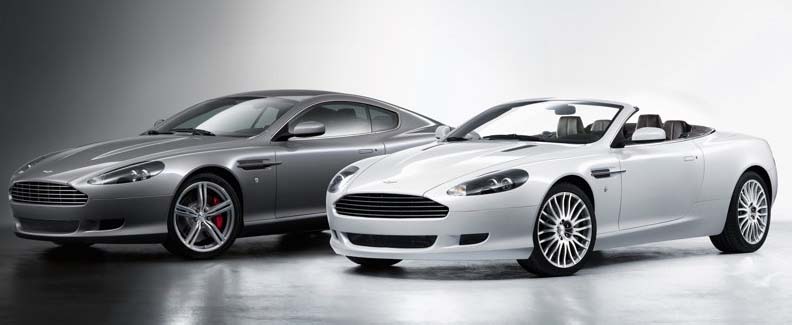
Aston Martin DB9 Volante, 2009

Aston Martin DB9 Volante, 2009


Aston Martin introduced a revised version of the company's critically acclaimed Aston Martin DB9 at the 2008 Geneva Motor Show, which includes significant enhancements to standard specification. These changes include a revised version of Aston Martin's 6.0 litre V12 engine to deliver improved power and torque. Peak power of 470bhp (350kW) - increased by 20bhp (30Nm) - is now reached at 6,000rpm, resulting in a power to weight ratio of 267bhp per tonne (199kW/tonne) - an increase of 11bhp per tonne over the existing Aston Martin DB9.

Peak torque of 600Nm is delivered at 5,000rpm, providing even more accessible power for the driver, as well a greater performance feel overall. Accordingly, top speed is now 190mph (306km/h) and the benchmark 0-60mph time improves by 0.3 seconds for the Touchtronic transmission - which benefits from a new valve box and integrated transmission controls to achieve quicker gear shifts - to 4.6 seconds and by 0.1 seconds to 4.6 seconds for the manual gearbox.

The latest Aston Martin DB9  incorporates a series of chassis developments for both the Coupe and Aston Martin DB9 Volante derivates. Bilstein dampers are introduced in addition to revised upper suspension arms and retuned suspension bushes to deliver improved ride quality; aiding greater refinement in the Aston Martin DB9 Volante and an enhanced sporting feel in the Coupe. The Aston Martin DB9 Volante also benefits from revisions to the front shear panel which increases torsional rigidity by 10%, further improving refinement.

The Aston Martin DB9 manages to combine all facets of style, quality and usability of a traditional Aston Martin without relying on retrospective detail or design. Accordingly, styling changes to the revised Aston Martin DB9 are subtle, reflecting the car's timeless design and understated elegance.

Exterior styling changes include the introduction of a new standard 19'' 10-spoke alloy wheel, new door mirrors and a revised anodised aluminium five-bar grille. In the cabin changes include a new centre console constructed from die cast zinc with a painted iridium silver finish and the introduction of a new Emotion Control Unit (ECU) - first seen on the Aston Martin DBS in 2007. The ECU - constructed from glass, polished stainless steel and polycarbonate - replaces the key used previously for the Aston Martin DB9.

The innovative Aston Martin DB9 introduced an exciting new era for Aston Martin. The 2+2 sports car set new standards in its class due to its astonishing combination of technology, agility and design. The car marked the beginning of a new era for Aston Martin and became the first car to be hand-made at the company's state-of-the-art facility in Gaydon, Warwickshire.

Aston Martin DB9, 2009

Aston Martin DB9, 2009


Aston Martin introduced a revised version of the company's critically acclaimed Aston Martin DB9 at the 2008 Geneva Motor Show, which includes significant enhancements to standard specification. These changes include a revised version of Aston Martin's 6.0 litre V12 engine to deliver improved power and torque. Peak power of 470bhp (350kW) - increased by 20bhp (30Nm) - is now reached at 6,000rpm, resulting in a power to weight ratio of 267bhp per tonne (199kW/tonne) - an increase of 11bhp per tonne over the existing Aston Martin DB9.

Peak torque of 600Nm is delivered at 5,000rpm, providing even more accessible power for the driver, as well a greater performance feel overall. Accordingly, top speed is now 190mph (306km/h) and the benchmark 0-60mph time improves by 0.3 seconds for the Touchtronic transmission - which benefits from a new valve box and integrated transmission controls to achieve quicker gear shifts - to 4.6 seconds and by 0.1 seconds to 4.6 seconds for the manual gearbox.

The latest Aston Martin DB9 also incorporates a series of chassis developments for both the Coupe and Aston Martin DB9 Volante derivates. Bilstein dampers are introduced in addition to revised upper suspension arms and retuned suspension bushes to deliver improved ride quality; aiding greater refinement in the Aston Martin DB9 Volante and an enhanced sporting feel in the Coupe. The Aston Martin DB9 Volante also benefits from revisions to the front shear panel which increases torsional rigidity by 10%, further improving refinement.
The Aston Martin DB9 manages to combine all facets of style, quality and usability of a traditional Aston Martin without relying on retrospective detail or design. Accordingly, styling changes to the revised Aston Martin DB9 are subtle, reflecting the car's timeless design and understated elegance.

Exterior styling changes include the introduction of a new standard 19'' 10-spoke alloy wheel, new door mirrors and a revised anodised aluminium five-bar grille. In the cabin changes include a new centre console constructed from die cast zinc with a painted iridium silver finish and the introduction of a new Emotion Control Unit (ECU) - first seen on the Aston Martin DBS in 2007. The ECU - constructed from glass, polished stainless steel and polycarbonate - replaces the key used previously for the Aston Martin DB9.

The innovative Aston Martin DB9 introduced an exciting new era for Aston Martin. The 2+2 sports car set new standards in its class due to its astonishing combination of technology, agility and design. The car marked the beginning of a new era for Aston Martin and became the first car to be hand-made at the company's state-of-the-art facility in Gaydon, Warwickshire.

Sales of the Aston Martin DB9 started in spring 2004, and to date, more than 10,000 examples have been produced and delivered to customers around the world - surpassing the Aston Martin DB7 as the most successful Aston Martin of all time.