Showing posts with label 2009. Show all posts

Monday, May 14, 2012

Spyker C8 Laviolette LM85, 2009

 
 Spyker C8 Laviolette LM85, 2009

The Spyker introduces the Spyker C8 Laviolette LM85 of which a maximum of 24 production slots are being offered. The LM85 has been designed in the spirit of the Spyker Squadron GT2 (LMES) race cars and sports a GT2 inspired livery. The Spyker C8 Laviolette LM85 is named after the starting number of the GT2 cars Spyker has had at Le Mans since 2002.

The Spyker C8 Laviolette LM85 specification list is exhaustive with exclusive elements incorporated. All 24 LM85 owners are special guest during the 24 Hours of Le Mans in June 2009. Furthermore, a special Chronoswiss 24 Hours Pilot Watch is part of the offer.

The Spyker C8 Laviolette LM85 is an advanced mid-engine, two-seat sports car. It is characterized by a lightweight all aluminium body construction and an uncompromising engineering package. The powertrain of the Spyker C8 Laviolette LM85 is the all aluminium Audi 4.2 Litre V8 engine producing 400 bhp. This is paired to a manual six-speed Getrag gearbox, driving the rear wheels with a Drexler limited slip differential. The use of aluminium parts and other lightweight materials results in an impressive power-to-weight ratio and underlines the GT2 racing heritage of the LM85.

Based on the Spyker C8 Laviolette GT2R, the racing characterisitics of the LM85 are numerous, such as the structural aluminium chassis, GT2 livery (Burnt Almond Orange with Gun Metal 'S' logo), side mirrors in gun metal, a carbon fibre rear spoiler, and GT2 windscreen streamer. Behind the black powder coated alloy wheels, black AP Racing 6 piston brake calipers with AP Racing logo appear.

The ample use of black leather and alcantara, which is originally meant to reduce light reflection during racing, has been finished with orange contrast stitching and characterizes the unique interior of the Spyker C8 Laviolette LM85.

 Chronoswiss dials and switches can be installed and are virtually identical to the Chronoswiss 24 Hours Pilot Watch every LM85 owner receives with his car. The black floor mats are made of fire protective material, finished with orange piping and the LM85 logo embroidered.

Pilot Watch
Every Spyker C8 Laviolette LM85 owner receives a special edition Spyker Chronoswiss 24H Pilot Watch with orange crocodile strap. The serial number of the car will be engraved on the case of this exquisite time piece.

Le Mans VIP Weekend
Racing is of key importance to Spyker as it breeds the brand and highlights the endurance and performance capabilities of our cars. Spyker therefore has had its own factory race team since its inception in 2000: Spyker Squadron. In 2009 Spyker Squadron will participate in the 24 Hours of Le Mans for the seventh time. The 24 Hours of Le Mans is a unique event for both racing fans and drivers. As part of the LM85 offering all Spyker C8 Laviolette LM85 owners are invited to celebrate and experience the 24 hours of Le Mans 2009. During this VIP Hospitality weekend, Spyker hosts the owner and guest at the most famous sports car endurance race, held on the "Circuit de la Sarthe".

Exterior Features
  •     * Body colours: Burnt Almond Orange with Gun Metal "S" logo
  •     * Side mirrors in Gun Metal
  •     * GT2 carbon fibre rear spoiler in Burnt Almond Orange
  •     * Spyker GT2 windscreen streamer
  •     * Towing eye and towing ring in orange
  •     * Charcoal tinted polycarbonate roof panels
  •     * Aluminium front body gurney
  •     * 19" Black Aeroblade Wheels with central wheel nut
  •     * Black AP Racing logo'ed calipers

Interior Features
  •     * Airbag steering wheel trimmed in black alcantara and black perforated leather grab areas; orange stitch
  •     * Dashboard top panel trimmed in black alcantara; orange stitch
  •     * Centre tunnel and sills trimmed in black quilted alcantara; orange stitch
  •     * Knee area dashboard and glove box trimmed in black quilted leather; orange stitch
  •     * Door panels in black leather; quilted inlays in black quilted alcantara; orange stitch
  •     * Roof upholstery in black alcantara
  •     * Trunk panels in black quilted leather; orange stitch
  •     * Fire protective floor mats in black; orange piping; LM85 logo embroidered
  •     * Dashboard instrument panel in turned aluminium
  •     * Personalised LM85 serial plaque
  •     * Spyker logos in head rests
  •     * Extinguisher system mounted at passenger's side
  •     * Special engine covers (silk black)
  •     * Whisper mode operated exhaust system

Additional Features
    * Spyker Chronoswiss 24H Pilot Watch with orange crocodile strap; LM85 serial number engraved
    * Exclusive Spyker VIP Hospitality 24H LeMans 2009 weekend

Optional Features
    * Sticker set 1 (number 85, driver's name and national flag)
    * Sticker set 2 (Complete 2009 LeMans sponsors)
    * Chronoswiss dials and switches
    * Car cover; black with orange piping; LM85 serial number embroidered

Safety & Security
    * Driver's airbag steering wheel
    * 3 Point restraining system, integral steel seat-belt support structure
    * Remote-controlled central locking system
    * Alarm system with immobilizer
    * Bi-Xenon headlights

Technical Specifications
    * Body & Chassis
          o Frame: Structural Aluminium Space Frame
          o Body: Full aluminium body
          o Suspension: Fully independent and adjustable aluminium wishbone suspension Koni F1 Shock Absorbers, Eibach Springs, anti roll bar
          o Active safety: Anti-lock Braking System (ABS)
          o Brake Calipers: Aluminium AP Racing calipers
          o Brake discs (front - rear): Ø356 mm (14") - Ø330 mm (13") AP Racing
          o Pistons (front/rear): 6/4 AP Racing
          o Wheels (front - rear): 8,5J x Ø19" - 9,5J x Ø19"
          o Tyres (front - rear): 235/35 R19 - 265/30 R19
          o Rear spoiler: Fixed wing
    * Engine & Transmission
          o Engine type: Mid-mounted V8, 40 Valve
          o Engine capacity: 4172 CC (254.6 cu in.)
          o Maximum Power: 298 Kw (400 hp)
          o Maximum torque: 480 Nm
          o Maximum revolutions: 7500 rpm
          o Fuel Injection System: Multi-Point with Electronic Ignition
          o Differential: Drexler Limited Slip Differential
          o Gearbox: Synchromesh 6-Speed Transaxle, Getrag manual gearbox
    * Dimensions
          o Wheel base 2575 mm (101")
          o Front track 1400 mm (55")
          o Rear track 1580 mm (62")
          o Length 4185 mm (165")
          o Width ex mirrors 1880 mm (74")
          o Height 1245 mm (49")
          o Kerb weight 1275 Kg (2805 lbs)
          o Weight distribution: front / rear 43% / 57%
          o Specific Power: kg/hp 3.125
          o Max. Allowable Weight 1500 kg
          o Max. Allowable Weight in trunk 50 kg
    * Consumption (in accordance with Dir. EC/1999/100)
          o Urban cycle: 19,0 L/100 km
          o Extra urban cycle: 10,0 L/100 km
          o Combined: 13,3 L/100 km
          o CO2 emission 315 g/km
    * Consumption US (in accordance with US EPA guidelines)
          o Urban cycle: 13 mpg: Expected range for most drivers 12 to 18 MPG
          o Extra urban cycle: 18 mpg: Expected range for most drivers 16 to 24 MPG
          o Combined: 15 mpg
    * Tank capacities
          o Fuel tank: 60 litres (15,9 gallons)
          o Engine oil: 8 litres (2,1 gallons)
          o Engine coolant: 20 litres (5,3 gallons)

Pagani Zonda Cinque, 2009


  •  Pagani Zonda Cinque, 2009

A project born to satisfy the request of the Pagani dealer for Hong Kong "SPS", an incredibile car which will be produced only in 5 (five) limited pieces, already all sold and will be street legal. It will be the first Pagani car to be equipped with sequential gearbox manageable both with paddles behind the steering and with the traditional gear stick on central tunnel. Besides, it will be the first Zonda to use the new Pagani invention, the carbon-titanium, a special fiber purposely created for the Zonda Cinque, which will be eventually used on the new generation models. This monster has 678 hp, 780 Nm torque, forged monolock titanium wheels, bolts and nuts will fully be done in titanium and boast the Pagani logo.

The interiors are refined and at the same time reveal the sporting attitude of this car. Racing leather seats developed by Toora, 4-points seatbelts and molibden steel roll-bars with carbon fiber coating.

The Zonda Cinque total weight will be 20 Kg lighter then the F model, will have new Pirelli tyres, with special compounds for the car.

Suspensions and springs will be in ergal and titanium developed with the latest technology from Öhlins, in accordance with the Pagani specifications. Four different settings, 10 adjustments each, to separate high and low frequencies, both in compression and extention.

The body is equipped with a longer front spoiler, new designed rear wing, central air intake on monocock, extra air intakes for rear brakes. Flat bottom and new rear air extractors will improve the downforce up to 750 Kg at 300km.

Technical Specifications:
  •     * Mercedes Benz AMG engine, 678 hp,
  •     * ECU, Traction control , ABS by Bosch
  •     * Inconel/titanium exhaust system coated with ceramic
  •     * Suspensions in magnesium and titanium
  •     * Cima sequential gearbox (6 speed), robotized by Automac enginnering
  •     * APP monolitic wheels forged in aluminium and magnesium. Size: front 9x19 - rear 12,5x20
  •     * Pirelli PZero tyres. Size: front 255/35/19 rear 335/30/20
  •     * Toora Racing Seats in carbon fiber, with leather cover
  •     * Carbon Fiber steering wheel
  •     * Brembo brakes in carbo-ceramic self ventilated with hydraulic servo brake, Size: front 380x34 mm, monolitic 6 piston caliper; rear 380x34 mm, monolitic 4 piston caliper.
  •     * Dry weight 1210 Kg
  •     * Weight distribution in driving condition: 47% front, 53% rear
  •     * Acceleration: 0-100 Km in 3.4 sec., 0-200 in 9.6 sec.
  •     * Braking: 100-0 km in 2.1 sec., 200-0 km 4.3 sec.
  •     * Maximum side acceleration: 1,45 G (with road tyres, NO CUP)

The Zonda Cinque will be a piece of art able to speed over 350 Km/h. A special colour livery will distinguish this unique, exclusive, 1ML Euro + tax model. Only five pieces for five wealthy Pagani lovers.

Tuesday, September 6, 2011

Dodge Circuit EV, 2009


Dodge Circuit EV, 2009

The Dodge Circuit EV displays bold exterior and interior styling with outstanding performance, zero gasoline consumption and zero tailpipe emissions.

The Dodge Circuit EV design screams pure sports car from every angle. The Dodge Circuit EV's profile demonstrates perfect proportions for balanced handling, placing the driver and passenger midway along the wheelbase. At the front of the vehicle, the distinctive Dodge crosshair grille splits the wind, sending it over the long, low hood and cleanly over the windshield and cockpit. The body sides feature a deep scallop, providing visual depth and also a functional rear-brake air duct. At the rear, the functional elements blend with design to create a uniform finish.

The Dodge Circuit EV is adorned in all-new "Tangoreen" exterior color, wearing large "EV" graphics on both sides of the sports car.

The uncomplicated interior of the Dodge Circuit EV delivers a combination of pure function and athletic refinement. The cockpit design puts complete control of the car at the driver's fingertips. Nestled within a leather-covered instrument cluster are two primary analog-face gauges. A digital display conveys information regarding the electric-drive system.
The seats feature deep bolsters and are covered in premium leather. The same premium leather covers the center console and the width of the instrument panel.

The Dodge Circuit EV delivers all of the convenience features of a performance sports car, including premium sound system, power windows and door locks, air conditioning, speed control.

Propelled by a completely electric ENVI drivetrain, the Dodge Circuit EV posts impressive performance numbers:
    * 0-60 mph in less than 5 seconds
    * ¼-mile in 13 seconds
    * Top speed of more than 120 mph

Perhaps the most impressive Dodge Circuit EV number, however, is zero. That's how much gasoline the vehicle consumes while providing exhilarating sports car performance. It's also how much tailpipe emissions are produced.

The Dodge Circuit EV utilizes just three powertrain components. These include a 200 kW (268 horsepower) electric motor to drive the wheels, an advanced lithium-ion battery system to power the electric-drive motor, and a controller that manages energy flow.

Working with the latest advanced lithium-ion battery technology, the Dodge Circuit EV has a driving range of 150 to 200 miles between charges - more than triple the average daily commute of most consumers. Recharging the vehicle is a simple one-step process: plugging into a standard 110-volt household outlet. The recharge time can be cut in half by using a typical 220-volt household appliance power outlet.

The Dodge Circuit EV offers driving enthusiasts a performance sports car that can be driven to work every day - without consuming gasoline or producing tailpipe emissions.

Dodge Challenger RT, 2009


Dodge Challenger RT, 2009

The all-new 2009 Dodge Challenger merges the best American muscle-car characteristics — unmistakable design, world-class handling, powerful engines and technology — to delight driving enthusiasts across several generations.

The Dodge Challenger is the first five-passenger, two-door coupe produced from Chrysler's proven rear-wheel-drive platform that delivers the Chrysler 300 and Dodge Charger. Developed with Dodge's credo of "bold, powerful and capable," the Challenger delivers a modern two-door muscle car.
Three models will be offered in North America: Dodge Challenger SRT8®, Dodge Challenger R/T and Dodge Challenger SE.

Essential Hardware

The Dodge Challenger R/T features the new-generation 5.7-liter HEMI® V-8 engine with a five-speed automatic transmission that produces an estimated 370 horsepower (276 kW) and 398 lb.-ft. of torque (540 N•m). For 2009, the HEMI engine is upgraded to get an estimated five percent improvement in fuel economy as well as an increase of 30 horsepower (9 percent) and 8 lb.-ft. improved torque (2 percent) over a greater range of engine speeds. The automatic transmission features fuel-saving multi-displacement (MDS) technology which increases fuel economy by as much as 20 percent depending on driving conditions without sacrificing vehicle performance. The Dodge Challenger R/T also offers a precision-shift six-speed manual transmission — the first for a new-generation HEMI-powered car — that produces 375 horsepower (280 kW) and 404 lb.-ft. of torque (548 N•m) when running on premium fuel. The Dodge Challenger R/T can go from zero to 60 mph in less than six seconds.

The 2009 Dodge Challenger SRT8 features an SRT-exclusive 6.1-liter HEMI V-8 engine mated with a new-for-2009 six-speed manual transmission or a five-speed automatic transmission with Auto Stick that generates a blistering 425 horsepower (317 kW) and 420 lb.-ft. of torque (569 N•m). The vehicle can go from zero to 60 mph in less than five seconds.
The Dodge Challenger SE powered by the 3.5-liter High Output V-6 with a four-speed automatic transmission produces 250 horsepower (186 kW) and 250 lb.-ft. of torque (339 N•m).

Patterned off the Dodge Charger architecture, the front suspension and five-link independent rear suspension system on all Dodge Challenger models provide excellent ride and handling characteristics.

Essential Styling

The Dodge Challenger design team stayed true to the concept revealed at the 2006 North American International Auto Show, while drawing upon elements from the original Challenger. The result: a bold, aggressive muscle machine that blends nostalgia with modern Dodge style.

On the exterior, the long, raised performance hood with scoops and recessed grille with round dual headlamps are reminiscent of the original Dodge Challenger. The bold A-line, or character line, that runs from stem to stern gives the all-new 2009 Dodge Challenger an instantly recognizable muscle-car profile. Retro dual rectangular exhaust outlets complete the look from the rear.

On the interior, the trapezoidal theme of the door-panel cove and gauge cluster, dark headliner and slanted shifter console are inspired by the original Dodge Challenger. The modern interpretation of the Dodge Challenger offers exceptional rear seating for a two-door coupe, achieving best-in-class rear head (37.4 inches) and leg (32.6 inches) room compared to the competition. Coupled with best-in-class cargo space (16.2 cu. ft.) — equal to the Dodge Charger — the all-new 2009 Dodge Challenger offers added comfort and functionality.

Essential Technology
The all-new 2009 Dodge Challenger offers customers a full range of innovative technologies:

    * MyGIG provides a cutting-edge multimedia audio and entertainment system, with built-in navigation
    * UConnect® Hands-free Communication System provides convenient, voice-activated communication with Bluetooth® cellular phones
    * SIRIUS® Digital Satellite Radio offers a variety of commercial-free radio programs and music
    * Keyless Go allows the driver to start the vehicle with the simple push of a button
    * Remote Start starts a secured vehicle with the key fob

More than 25 Safety and Security Features
Dodge Challenger offers more than 25 safety and security features:
    * Supplemental Side-curtain Air Bags extend protection to all outboard front- and rear-seat passengers
    * Anti-lock Brakes (ABS) modulate the brakes for the driver to provide steering control while braking
    * Electronic Stability Program (ESP) applies selective braking or throttle reduction to control oversteer and understeer
    * Brake Assist ensures maximum braking action during panic stops
    * Traction Control reduces the throttle and/or applies selective braking to optimize traction during acceleration
    * Hill Start Assist (HSA) for Manual Transmission application assists the driver in launching the vehicle on an incline
    * Automatic Headlamps turn headlamps on at dusk and off in the daylight without driver intervention
    * Tire Pressure Monitoring (TPM) alerts driver about low tire pressure(s) in order to facilitate safe handling

Sunday, August 7, 2011

GMC Sierra Hybrid Crew Cab, 2009


GMC Sierra Hybrid Crew Cab, 2009

GMC announced the 2009 GMC Sierra Hybrid, a powerful full-size pickup that achieves 40-percent greater city fuel economy and a 25-percent improvement in overall fuel economy while delivering the capability expected of a full-size truck - including a 6,100-pound (2,767 kg) towing capacity.

Partnering General Motors' patented two-mode hybrid system and a powerful 6.0L gas V-8, the Sierra Hybrid delivers highly efficient performance, including all-electric driving up to 30 mph (48 km/h). That allows fuel savings to be realized even when the truck is fully loaded or towing a trailer.

The GMC Sierra Hybrid goes on sale in the fourth quarter of 2008 and is based on the strong and capable Sierra platform that was introduced for the 2007 model year. It will be offered in the Crew Cab body style on both 2WD and 4WD models. Each model is equipped with several standard, popular features, including StabiliTrak electronic stability control system, a locking rear axle and a trailering package. Sierra Hybrid also offers dual-stage frontal air bags and head curtain side air bags, and it is the only full-size truck with five-star side-impact ratings in federal crash tests.

Hybrid details
The Sierra Hybrid's fuel-saving performance is derived from GM's advanced Electrically Variable Transmission (EVT) and 300-volt nickel-metal hydride Energy Storage System (ESS), which work in concert with the standard 6.0L V-8 gasoline engine with Active Fuel Management (AFM) and late intake valve closing (LIVC) technology. GM's hybrid technology system not only enables the Sierra to launch and drive up to 30 mph on electricity alone, it also allows the Vortec 6.0L V-8 engine to operate in its more economical V-4 mode for longer periods.

As part of the vehicle's emission control system, the ESS is warranted for eight years/100,000 miles.

With GM's two-mode hybrid system, the electric power used to propel the vehicle is generated by the hybrid system itself. When the brakes are applied or the vehicle is coasting, the electric motors within the hybrid system create electricity that is stored in the 300-volt battery. This stored energy is used to move the vehicle and the regenerative braking cycle is renewed.

The two-mode hybrid system provides seamless, dependable power on demand in an efficient package. In fact, its electric motor is less than half the size of those in single-mode hybrid systems. This technology was developed and is still used in fleets of hybrid transit buses in more than 70 North American and European cities. Scaled-down for use in passenger vehicles, the two-mode system delivers fuel savings where it is needed most - in large vehicles with high levels of capability. The two-mode system was first introduced on the 2008 Yukon Hybrid. It is a core part of GM's energy diversity efforts, which are centered on reducing dependence on petroleum, improving fuel economy, reducing emissions and minimizing the automobile's impact on the environment.

With the fuel savings of the hybrid system and Sierra's 26-gallon (98-liter) fuel tank, the Sierra Hybrid has a cruising range of more than 500 miles (800 km).

Quiet and smooth
Integration of the hybrid system on the Sierra is seamless - the battery pack is located beneath the rear seat - and perceptible only in what it lacks: noise.

Contributors to the quiet driving experience:
    New exhaust system and resonator tuned for the 6.0L engine's Active Fuel Management operation
    Additional engine intake induction tuning for reduced interior noise and pleasing sound quality
    Low-rolling resistance, "quiet-tuned" P265/65R18 tires for reduced road noise
    Electrically driven 300-volt air conditioning compressor reduces vibration and allows the standard, tri-zone HVAC system to cool the passenger compartment even when the gasoline engine is shut off
    Electrically driven 42-volt variable-assist power steering reduces vibration and provides up to a 0.5-mpg fuel economy improvement by reducing parasitic losses common in belt-driven hydraulic systems
    Energy Storage System (ESS) cooling system internal fan is tuned to be quiet at low vehicle speeds when the fan could more easily be heard by the occupants

Trailering performance
In addition to increased fuel economy, the GMC Sierra Hybrid's electrically variable transmission also provides tremendous trailering capability, enhancing driving smoothness and quality when towing. Electric drive is enabled up to approximately 30 mph (48 km/h), even when towing, allowing fuel savings when the truck is towing a trailer.
The EVT incorporates grade braking and tap up/tap down shift control. It also benefits towing on curves or lower-speed back roads, as exceptionally smooth gear transitions eliminate the "shift shock" torque disruption that can occur during abrupt shifts, such as when slowing or braking.

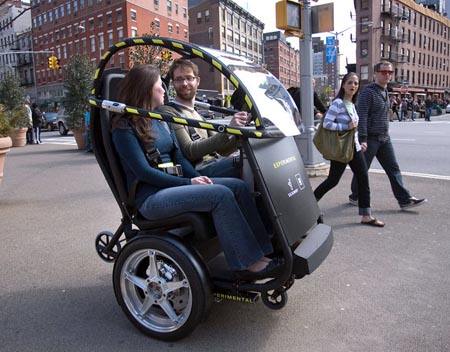
GM PUMA Concept, 2009


GM PUMA Concept, 2009

Dubbed Project P.U.M.A. (Personal Urban Mobility and Accessibility), GM and Segway are developing an electrically powered, two-seat prototype vehicle that has only two wheels. It could allow people to travel around cities more quickly, safely, quietly and cleanly - and at a lower total cost. The vehicle also enables design creativity, fashion, fun and social networking.

GM and Segway announced their collaboration, while demonstrating the Project P.U.M.A. prototype in New York City.

Trends indicate that urbanization is growing, and with that comes increased congestion and more competition for parking. Cities around the world are actively looking for solutions to alleviate congestion and pollution. Project P.U.M.A. addresses those concerns. It combines several technologies demonstrated by GM and Segway, including electric drive and batteries; dynamic stabilization (two-wheel balancing); all-electronic acceleration, steering and braking; vehicle-to-vehicle communications; and autonomous driving and parking. Those technologies integrate in Project P.U.M.A. to increase mobility freedom, while also enabling energy efficiency, zero emissions, enhanced safety, seamless connectivity and reduced congestion in cities.

Project P.U.M.A. vehicles will also allow designers to create new fashion trends for cars, and to focus on the passion and emotion that people express through their vehicles while creating solutions that anticipate the future needs of urban customers.

The Project P.U.M.A. prototype vehicle integrates a lithium-ion battery, digital smart energy management, two-wheel balancing, dual electric wheel motors, and a dockable user interface that allows off-board connectivity. The result is an advanced and functional concept that demonstrates the capabilities of technology that exists today.

Built to carry two or more passengers, it can travel at speeds up to 35 miles per hour (56 kph), with a range up to 35 miles (56 km) between recharges.

Since the introduction of the Segway Personal Transporter (PT), Segway has established itself as the leader in the small electric vehicle space. Its approach to congestion and environmental challenges is balanced with a strong understanding of the functional needs of its customers, enabling them to do more with less. Segway has delivered more than 60,000 lithium-ion batteries to the market.

GM has been a leader in "connected vehicle" technologies since it introduced OnStar in 1996. Today, this on-board communications package connects six million subscribers in North America to OnStar safety and security services. GM has also pioneered vehicle-to-vehicle (V2V) communications systems and transponder technology. These and additional connected vehicle technologies could ultimately enable vehicles that don't crash and drive themselves.

Monday, March 14, 2011

Land Rover Freelander 2 TD4 e, 2009

Land Rover Freelander 2 TD4 e, 2009

The new Land Rover Freelander 2 TD4_e is Land Rover's most fuel-efficient vehicle to date. Featuring a new intelligent Stop/Start system, it is the first production vehicle to incorporate technologies from the company's programme of sustainable engineering initiatives, collectively named 'e_TERRAIN TECHNOLOGIES'.

On the standard EU4 cycle, the CO2 emissions of the Land Rover Freelander 2 TD4_e are reduced by 8 per cent, compared with the outgoing manual diesel Land Rover Freelander 2. Moreover, in additional tests, Land Rover engineers have measured fuel savings approaching 20 per cent in heavy urban traffic.

The 8 per cent improvement equates to a CO2 emissions reduction of 15 g/km compared with the standard Freelander 2 TD4 manual (from 194 g/km to 179 g/km). In terms of fuel efficiency, consumption is reduced from 7.5 l/100 km to 6.8 l/100 km, a saving of 0.7 litres of fuel every 100 km (62 miles).

These gains, coupled with the added benefits of the gearshift indicator light, software developments and efficiencies from low-rolling-resistance tyres, make the Land Rover Freelander 2 TD4_e the most fuel-efficient production Land Rover ever built.

Sophisticated controls ensure that the Stop/Start system does not compromise the needs of either the driver or the vehicle. For the engine to shut down, the vehicle must be stationary, the gearbox in neutral and the clutch pedal raised. To re-start, the driver simply depresses the clutch and the enhanced starter motor engages the engine, ready for when first gear is selected.

Added fuel economy benefits
Along with the intelligent Stop/Start system, the Land Rover Freelander 2 TD4_e includes a series of additional enhancements that help to deliver fuel economy and CO2 benefits.
A new gearshift indicator light in the instrument pack advises the driver when to change gear if a higher gear will allow the vehicle to operate more fuel-efficiently. This is calculated by the Land Rover Freelander 2 TD4_e's fully mapped engine.

Software developments to the driveline systems on the Land Rover Freelander 2 TD4_e generate CO2 benefits without reducing Land Rover's renowned capability.

Land Rover engineers are also collaborating with tyre suppliers to drive improvements to fuel economy through reduced rolling losses. Tyre characteristics including rolling resistance are optimised for the entire range of available tyre sizes on Freelander 2 models.

Refined Stop/Start operation
Land Rover engineers have invested considerable effort in safeguarding levels of engine refinement. To reduce the engine shake associated with some diesel engines when stopping, the Land Rover Freelander 2 TD4_e features controlled throttle closing and ramps down fuel in a smooth fashion, while the alternator is also turned off during the shut-down procedure, reducing load on the engine. A software feature change and revised engine calibration further aid smooth shut-off, while engine shake on start-up is reduced by the Freelander 2's optimised engine-mounting strategy and inherent tuning.

Uncompromised durability
The increased frequency of stop-start cycles over the lifetime of the Land Rover Freelander 2 TD4_e will lead to increased use of the vehicle's affected components, so enhanced durability of these components was a priority for the Freelander 2's engineering team. They developed a new heavy-duty starter motor, a new ring gear, a new dual mass flywheel friction control plate and an absorption glass mat battery. These new features ensure that the Land Rover Freelander 2 TD4_e delivers characteristic Land Rover all-terrain performance and that the system's operation is always rapid and reliable.

Enhanced starter motor
The more frequent stop and start activity means that demands on the starter motor are forecast to increase up to threefold during the lifetime of the Land Rover Freelander 2 TD4_e. To accommodate the durability demands on the vehicle's 2 kW starter motor, a number of changes have been made.

The grease seals have been enhanced significantly and new hard-wearing copper contact material has been sourced and specified across the TD4_e range to enhance wear resistance within the starter solenoid.

New ring gear
An all-new ring gear is specified for all TD4_e models to cope with the increased frequency of starts. The ring gear is attached to the engine flywheel and comes into contact with the starter motor each time the engine is started. The new ring gear is manufactured from a harder grade of steel and contains over 25 per cent more carbon to improve durability.

Dual mass flywheel friction plate
Diesel-powered Freelanders with manual gearboxes have always featured a dual mass flywheel to ensure engine refinement at start, stop and low speeds. A new Polyetheretherketone friction control plate has been developed for the Land Rover Freelander TD4_e. This is able to withstand seven times the pressure of the outgoing plate, to ensure greater levels of refinement under even greater start and stop demands.

Absorption glass mat battery
New absorption glass mat technology has been developed, which offers deeper discharge and recharge characteristics and reduces battery deterioration under much heavier usage. Fine glassfibre matting has been introduced to sit pressurised between the new absorption glass mat battery plates. This aids the battery's longevity in two ways: by allowing the electrolyte to function normally under greater pressure and by providing mechanical support for the plates, reducing battery degradation.

Intelligent technologies
Land Rover engineers focus on the introduction of intelligent, appropriate technologies, and the Land Rover Freelander 2 TD4_e is no exception. In congested traffic, when the Stop/Start technology will shut down the engine frequently, other features and technologies will not be compromised, so in-car entertainment, climate control, Bluetooth, driver information and other electronic systems will continue to function.

Technologies such as the new voltage quality module, the battery monitoring system, the brake vacuum sensor and the enhanced climate control system have been developed to ensure that such services continue uninterrupted in a stop situation.

Voltage quality module
The voltage quality module maintains critical vehicle systems, safety and occupant comfort. It supplies a constant voltage around the vehicle's electronic components during a stop-start, ensuring that key services continue uninterrupted by the sudden outrush of amps from the battery.

Battery monitoring system
This system monitors the battery's 'state of health' to ensure that the Stop/Start feature functions reliably. The technology is constantly at work, measuring factors such as natural battery degradation, ambient temperature, charge and discharge activity and voltage, to make sure there is enough power available for an effective stop-start.

Brake vacuum sensor
The Freelander 2's brake system is specified with significant vacuum reserves, but these reserves can become depleted for a number of reasons, such as use of the brake pedal when the engine is switched off. Ultimately this would lead to vacuum reserves becoming exhausted, which would affect the brake servo's operation and pedal loads, in some cases causing them to rise substantially.

To mitigate this, the brake vacuum sensor is specified on all Land Rover Freelander 2 TD4_e models, and if vacuum reserves fall to a level that will affect brake pedal loads, the system overrides the Stop/Start function until the brake vacuum is replenished - ensuring brake pedal loads are maintained.

Thursday, January 20, 2011

Honda Skydeck Concept, 2009

Honda Skydeck Concept, 2009


The 2009 Tokyo Motor Show mark the debut of the Honda Skydeck Concept, an innovative 6-seater hybrid MPV. This is still a design study, but is a great example of how Honda's IMA technology can be placed in a range of different cars for different needs. To give the Honda Skydeck Concept the practicality of a conventional MPV, many of the hybrid system components - including the high power battery - are housed in the car's centre tunnel (rather than behind the rear seats or under the floor, as with previous production hybrids). This allows for greater cabin space, and the room for three rows of two seats. It also gives a lower centre of gravity.

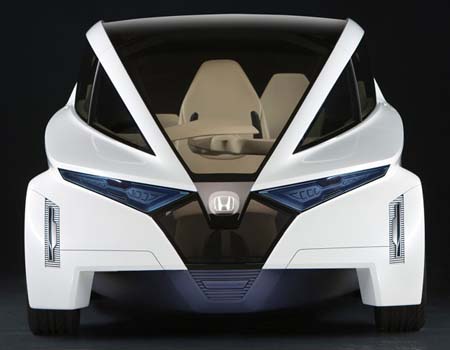
Honda P-NUT Concept,2009

Honda P-NUT Concept,2009


The Honda P-NUT Concept (Personal-Neo Urban Transport) demonstrates a futuristic concept for an ultra-compact and sophisticated city coupe, American Honda Motor Co., Inc., announced at the 2009 Los Angeles Auto Show.

Conceived around a small "footprint" for maximum convenience in tight urban settings, the packaging concept integrates a center driving position configuration and a rear powertrain layout. The exterior styling leverages crisp angles with dynamic flowing lines that originate from the front of the vehicle and span outward toward the rear. The end result is a sleek and aggressive exterior that also allows for a spacious and open interior with excellent visibility.

The exterior styling is intended to capture a future direction for premium sophistication while balancing the need for maximum interior space and an aerodynamic appearance. The interior layout, in conjunction with the rear powertrain design, contributes prominently to the exterior's overall shape.

The layout of the interior space, with its center driving position flanked by two rear seats, provides generous legroom for all occupants, roughly the equivalent of a mid-sized sedan in a vehicle that has an exterior footprint similar to a micro car. Interior functionality is increased by rear seating areas that fold up and out of the way to increase storage capacity. The windshield serves as a heads-up display for the navigation system and the back-up camera.

The modular rear engine bay, depicted on the exterior by blue composite material, is designed to accommodate a wide variety of potential propulsion technologies including a conventional small displacement internal combustion engine, a hybrid gasoline-electric powertrain, or a battery-electric powertrain.

The Advanced Design Studio of Honda R&D Americas, Inc. in Los Angeles developed the Honda P-NUT Concept. Honda R&D Americas began its operations in California in 1975 with local market research activities and has steadily grown its capabilities over the past 33 years to include all aspects of new vehicle research, design and development. Recent Honda-brand efforts include trend-setting products such as the Pilot, Ridgeline, Element, Civic Coupe and Civic Si Coupe.

Specifications
    * Size class: Ultra-compact
    * Layout: Rear-engine, rear-wheel-drive
    * Passengers: 3
    * Length: 3,400 mm
    * Width: 1,750 mm
    * Height: 1,439 mm
    * Powertrain: Internal-combustion engine, hybrid-electric or battery-electric

Honda Pilot Prototype 2009

Honda Pilot Prototype 2009


The prototype conveys the design features of the more boldly-styled 2009 Pilot, which emphasizes authentic SUV styling, clever and more accommodating interior packaging and advanced technologies for safety, fuel efficiency and convenience.
The functional eight-passenger seating, a hallmark of the Pilot, becomes even easier to access in the third row as key dimensions for legroom, cargo and occupant space increase in all seating positions. A redesigned platform allows even more refined handling and ride comfort to exist seamlessly with all-weather and medium-duty off-road capabilities.
The Pilot will feature the Honda-exclusive Advanced Compatibility Engineering™ (ACE) body structure and the most extensive use of high-strength steel in any Honda product to date.

The ACE body structure enhances frontal collision compatibility with vehicles of different sizes and bumper heights. A pedestrian injury mitigation design in the front of the vehicle is designed to help absorb energy in the event of a collision.
A crossover SUV platform underpins the Pilot to provide the best of the car and truck worlds by integrating the refined traits and packaging advantages of a unit body car design with the utility and capability of an SUV design. A V-6 engine introduces the latest generation of Honda fuel-saving Variable Cylinder Management™ (VCM) technology that operates in 6-cylinder mode for power and 4- and 3-cylinder modes for efficiency, an improvement compared to the existing Pilot's available VCM system that works exclusively in 6- and 3-cylinder modes.

The three rows of seats provide a high degree of adaptability for people and large cargo loads. The first row provides a commanding view of the road from two captains' chairs. A wide center stack and center console form the styling anchor for the interior with a design that emphasizes spaciousness and power, while allowing for convenient access to navigation, entertainment and climate-control systems.
The 60/40 split second row, more spacious, slides further forward for increased ease of access to the third row. The 60/40 split third row, now supplies enough knee room for an above-average-sized adult male to fit comfortably, making the Pilot's third row among the most practical in the industry. Each side of the second and third row independently folds down for cargo. A flat floor is created when the second and third rows are folded down.
Among its numerous accolades, the Honda Pilot has earned Car and Driver Magazine's prestigious "5Best Truck" award on six consecutive occasions (2002-2007). The current-generation 2008 Pilot is also among an elite group of vehicles to receive both a "Top Safety Pick 2008" from the Insurance Institute for Highway Safety (IIHS) and a 5-star crash safety rating for frontal and side collisions from the National Highway Traffic Safety Administration (NHTSA).